How to Strategically Place HVAC for a Noise-Free Home
Maintaining a quiet home is essential for every homeowner to enjoy a truly peaceful space. Sometimes a noisy AC can cause a lot of stress and even ruin your sleep. Mechanical sounds can be distracting for both you and your family.
Personally, I recommend focusing on the placement of an air conditioner to remove unwanted humming from your home. During the installation, I talk about placement beforehand. However, after installation, people often ask me if they should move because they can’t bear the existing noise anymore.
I’ve put together a guide for the placement of your air conditioning unit so you can get minimal noise. Here you will learn everything from picking the best indoor spots to soundproofing your outdoor unit.

|
TL;DR |
Why Reducing AC’s Noise Matters
Noise reduction is important because constant mechanical humming and vibrations can disrupt your sleep, lower your productivity, and increase stress levels within your home. To be honest, noise pollution is not just a minor nuisance.
Some studies have even shown that at the loudest façade, the risk of health-related stress increased by 2% for every 10-dB increase in noise level. If you work from home, a loud HVAC unit can make it impossible to focus…
I always tell my clients that achieving invisible comfort means your system should be felt, but never heard.
Beyond your comfort, noise is often a sign of a system in distress. Noises, even in sized ductless mini-splits, often stem from choked air or vibration against the wall. That means they are working harder and wearing out faster.
Role of Placement on Mini-Split’s Noise Levels
Your mini-split’s location directly determines the vibration and airflow noise in your living space.
Where you mount your unit indicates how sound waves behave, regardless of whether you are planning for a single-zone or multi-zone. If you bolt a system to a thin wall, the wall’s surface acts like a speaker, vibrating throughout the house.
Structural contact turns Durham walls into speakers, while restricted intake causes a loud whooshing sound. Hard surfaces like brick also reflect and amplify mechanical hums.
| Feature | Acoustic Serenity (Good) | Mechanical Disturbance (Bad) |
| Indoor Wall | Solid Exterior | Hollow Interior (Shared) |
| Ceiling Gap | 6–12 Inches | Under 3 Inches (Whistling) |
| Outdoor Base | Gravel/Composite Pad | Wooden Deck (Amplification) |
At Alternative Aire, we perform a sound path audit for every installation to keep things quiet from day one. If you’re hearing too much sound, call us to check your placement anytime!
Where to Place Your Indoor Unit for Noise Reduction?
Mounting your indoor unit on a solid exterior wall with 6–12 inches of ceiling clearance is the first step toward silence. Solid walls absorb motor hums better than thin interior partitions. It prevents vibrations from traveling through the house. Rubber spacers decouple the unit from the wall frame.
The 6-12-7 Rule ensures proper airflow and whisper-quiet operation. Placing the unit 7 feet high with a 12-inch ceiling gap prevents the loud whistling caused by a choked intake. This breathing room keeps the system both quiet and efficient.
Avoid tight corners and glass windows to prevent the Bunker Effect. These hard surfaces reflect and amplify mechanical noise. Maintaining one foot of side clearance stops sound waves from bouncing back into your living space.
I follow ASHRAE standards to find the quietest spot in your home. If your current system is noisy, a placement audit can identify the cause.
Steps to Make a Mini Split Quieter in the Bedroom
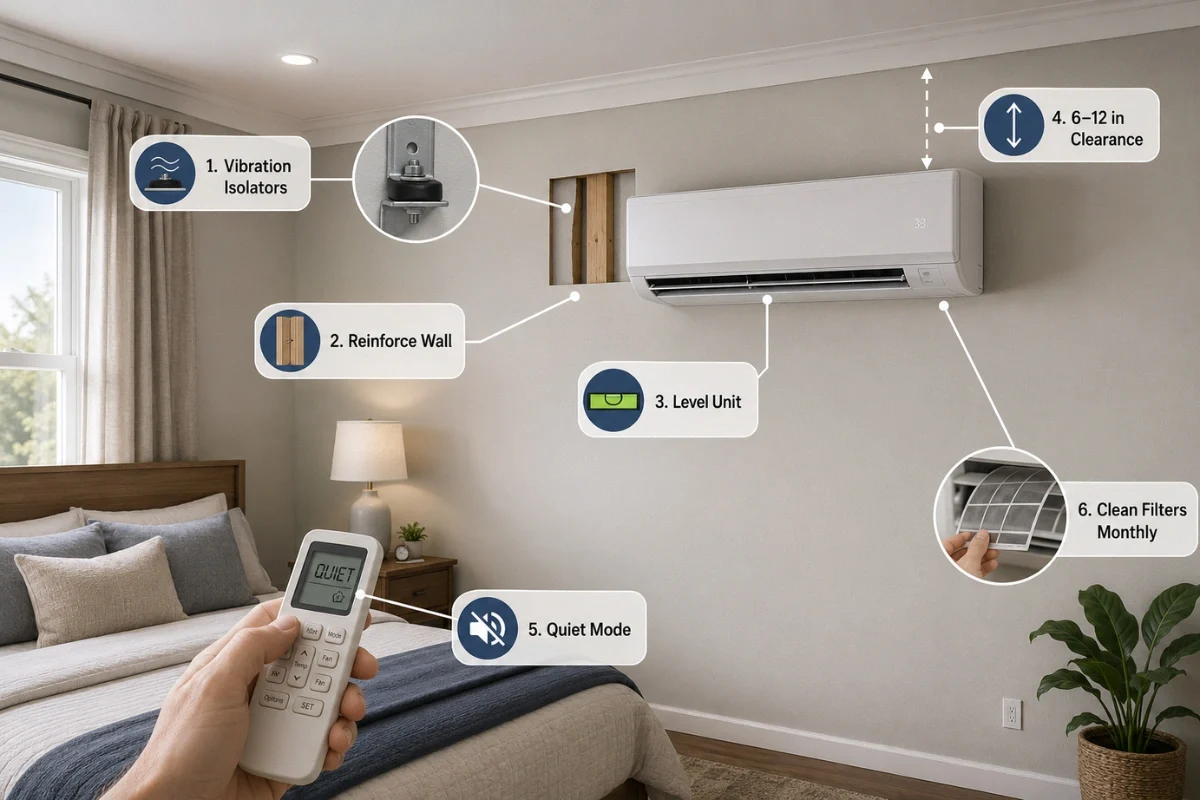
You can make a mini-split quieter in your bedroom by using vibration-isolation gaskets and setting the fan speed to its lowest Quiet Mode setting. It’s a helpful tip even if you are using your mini-split for a 200-500 sq ft room.
Since bedrooms are naturally quiet, small mechanical sounds are much more noticeable, making proper dampening essential. Following these steps can transform a disruptive hum into a faint, distant whisper.
- Step 1: Install Vibration Isolators: Place neoprene or rubber gaskets between the mounting bracket and the wall. This breaks the vibration path and prevents your drywall from acting like a speaker that amplifies motor pulses.
- Step 2: Reinforce Thin Walls: If the mounting surface is hollow or thin, add a mounting board or reinforce the studs. This extra mass stops the wall from rattling or resonating while the unit is running.
- Step 3: Level the Fan Wheel: Ensure the indoor unit is perfectly level during installation. An off-kilter unit causes the fan wheel to become unbalanced over time, leading to a rhythmic thumping or wobbling sound.
- Step 4: Clear the Airflow Path: Maintain a 6–12 inch gap from the ceiling and avoid tight corners. Proper clearance prevents air turbulence and the gasping sounds associated with high static pressure.
- Step 5: Set to Quiet Mode: Use the remote to lock the fan at its lowest consistent speed. This avoids the sudden revving noises that occur when the system tries to reach a temperature goal too quickly, or when utilizing specific dehumidification modes for Durham summers to keep the air comfortable and silent.
- Step 6: Clean Filters Monthly: Remove dust from the filters every 30 days to keep the intake silent. Clogged filters force the motor to work harder and create high-pitched whistling as air struggles to pass through.
I use specialized mounting kits and high-quality hardware that exceed standard requirements to ensure total peace. If your current system is keeping you awake, a professional noise audit can pinpoint exactly which step will fix the problem.
Strategic Outdoor Placement for a Quieter Home
Mount your outdoor unit at least 15 feet from windows on a level, gravel-based surface to minimize noise.
Placing the unit in this golden zone allows sound waves to dissipate before reaching your living areas. Avoiding narrow alcoves is equally important, as tight spaces trap compressor hums and create an echo chamber. Ideally, locate the system on the North or East side of your home; the natural shade keeps the unit cooler, reducing the compressor’s workload and lowering decibel levels.
It’s a huge factor when you consider that duct losses can account for more than 30% of energy consumption for space conditioning in older, ducted homes. By going ductless and choosing the right foundation, you’re already ahead.
The foundation choice is the final step in preventing unwanted noise. Wooden decks act like drums that amplify vibrations, so a heavy composite pad on a bed of gravel is the superior choice for scattering sound waves. This setup ensures your system remains neighbor-friendly and complies with local Durham noise ordinances and property line setbacks.
As an experienced HVAC installer, I use site-mapping and AHRI-certified pads to balance performance with acoustic distance. I also handle all North Carolina Mechanical Code requirements and permits to ensure a legal, quiet installation, while considering factors like sizing a mini split for the Durham climate for optimal efficiency.
How to Manage Noise With the Connector Path?
Stop noise from traveling through your home by using insulated line set covers and sealing wall penetrations with acoustic-grade caulk.
Copper refrigerant lines often vibrate against wood studs, creating a ticking or popping sound known as the oil canning effect. Using cushioned clamps and insulated hangers prevents this metal-on-metal contact by absorbing pipe expansion and contraction. This simple step stops your walls from amplifying mechanical vibrations.
Fluid dynamics also play a role; sharp 90-degree bends create whistling turbulence as refrigerant moves through the pipes. Using gentle, sweeping bends ensures smooth, quiet flow throughout the system. Finally, sealing wall penetrations with thick acoustic caulk blocks outdoor compressor hum from leaking into your rooms.
Most expert installers use vibration-free paths using strict North Carolina Mechanical Code standards. Ensure all wall penetrations are airtight and sound-dampened for maximum quiet, while paying close attention to line set routing and condensate drainage to avoid structural rattles.
How to Troubleshoot Mini-Split Noise?
Identifying the cause of a noisy mini-split starts with listening for specific mechanical cues. Most sounds act as diagnostic signals that help distinguish between simple maintenance needs and potential mechanical failures. Knowing these sounds can save you stress and prevent small issues from turning into expensive repairs.
- Rattling and Buzzing: Rattling is usually caused by loose panels or brackets that need tightening. Constant buzzing can indicate electrical harmonics or a failing valve, which requires a professional inspection.
- Gurgling and Whistling: Gurgling often points to a drain line that is not pitched correctly, causing water to back up. Whistling is typically a sign of clogged filters, forcing the system to gasp for air.
- The Winter Whoosh: Hearing a loud sigh or seeing steam in cold weather is a normal part of the defrost cycle. This process reverses the refrigerant to melt ice off the coils and should only last a few minutes.
I prefer advanced tools to check electrical loads and static pressure, taking the guesswork out of repairs. Professional services can translate your system’s language to keep it running quietly. If your system is making unusual noises, it is high time for a diagnosis or professional AC repair to find the root cause.
Correct Ways to Block Outdoor Noise
When trying to quiet an outdoor unit, you must prioritize air circulation over total enclosure. Building a tight box around a condenser causes it to overheat and fail prematurely. Effective soundproofing requires using dense materials that block low-frequency hums without suffocating the equipment.
- Use Mass-Loaded Vinyl (MLV) or louvered fences to block the sound path. These heavy materials stop sound waves while allowing the unit to breathe.
- A raised mound of earth, or an acoustic berm, is a highly effective natural barrier. It blocks noise from reaching your neighbors without affecting system performance.
- Specialized, weather-resistant blankets can be wrapped around the compressor itself. These are designed specifically for HVAC units to soak up noise without restricting vital airflow.
I follow ASHRAE standards to design barriers that protect your system’s lifespan while keeping your backyard peaceful. Using DIY materials like egg cartons or thin foam would not block heavy humming and can create a fire hazard.
Conclusion
All in all, a quiet mini-split is a great investment for your home’s peace. You cannot expect a silent system without 6–12 inches of ceiling clearance and a 7-foot mounting height.
Along with that, Alternative Aire recommends keeping the outdoor unit 15 feet from windows on a gravel base. Sealing wall penetrations with acoustic caulk may seem tedious, but you can enjoy a silent environment quickly.
Frequently Asked Questions
What Is The Quietest Decibel Level For A Mini-Split?
High-quality units operate between 19 and 24 decibels, similar to a whisper. To maintain this, you must keep the fan on its lowest setting and ensure the filters are clean.
Can I Hide My Outdoor Unit Behind A Solid Fence To Block Noise?
You should only use a louvered fence, as solid barriers trap heat and restrict airflow. This suffocates the unit, causing the compressor to get louder before it eventually fails.
Will A Sound Blanket Void My HVAC Warranty?
Professional blankets designed for your specific model usually would not void warranties. However, you must avoid DIY wraps that block cooling vents, as overheating will lead to a denied claim.
Why Does My Mini-Split Make A Popping Sound In The Morning?
This is typically thermal expansion of the plastic casing or copper lines as they heat up. The sound is normal and should stop once the system reaches a stable operating temperature.
How Far Should A Mini-Split Be From A Tv Or Microphone?
Maintain at least 3 to 5 feet of distance to avoid interference. Even quiet units create airflow turbulence that microphones can pick up as wind noise during calls or recordings.
Does A Dirty Mini-Split Become Louder Over Time?
Yes, dust buildup on the fan wheel causes it to become unbalanced and vibrate. You have to clean the blower wheel and filters regularly to keep the rotation smooth and silent.
Category: Blog
Subscribe
If you enjoyed this article, subscribe to receive more just like it.