5 Common Ductless Errors and Maintenance Alerts to Watch
Ductless mini split systems can show early warning signs before a major breakdown. Common ductless errors are weak airflow, poor heating or cooling, water leaks, ice buildup, unusual sounds, rising energy use, frequent cycling, blinking lights and error codes. Simple maintenance can resolve some issues. However, refrigerant, electrical, compressor, sensor and communication faults usually need professional service.
What Are the Most Common Ductless Maintenance Alerts to Watch?
The most common maintenance alerts include dirty filters, restricted airflow, dust buildup, reduced output, unusual odors and debris around the outdoor unit.
• Dirty or clogged air filter
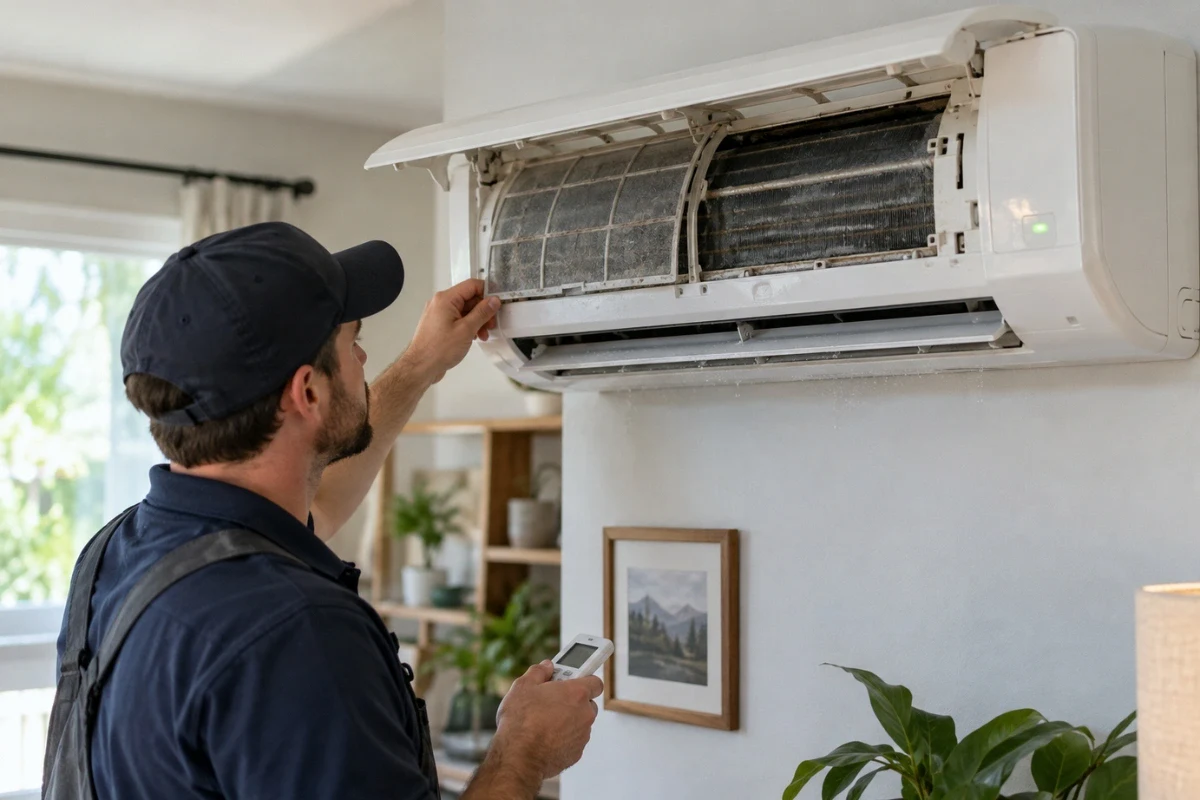
A dirty air filter is one of the easiest problems to spot. Dust collects on the filter as air moves through the indoor unit, gradually restricting airflow. A clogged filter can make the system work harder while delivering less conditioned air.
Check the filter during periods of heavy use. Clean it according to the manufacturer’s instructions or replace it when required. Proper mini split maintenance with filter cleaning can help keep airflow steady and reduce buildup on internal components.
• Reduced airflow
Reduced airflow can also point toward a dirty indoor coil, blower wheel or other airflow restriction. If cleaning the filter does not restore normal airflow, the problem may need a professional inspection.
• Dust buildup
Dust around the indoor unit can signal skipped cleaning. Dirt may collect around the intake grille, louvers and cabinet, reducing air movement and affecting indoor air quality.
• Outdoor debris
The outdoor unit needs attention as well. Leaves, grass, weeds, branches and other debris can restrict airflow around the condenser. Keep the area open so the unit can release heat properly.
• Unusual odors
Unusual odors also deserve attention. A dusty smell may appear after a long idle period. However, a persistent musty odor can point toward moisture or biological growth inside the system.
Which Ductless Warning Signs Mean There May Be a Bigger Problem?
Water leaks, ice buildup, strange sounds, frequent cycling, long run times and sudden performance changes can indicate a deeper mechanical or refrigeration problem.
• Water leaks or moisture
Water around the indoor unit can result from a clogged condensate drain, damaged drain pan or drainage problem. Condensation needs a clear path away from the unit. When water cannot drain properly, it may collect indoors.
• Ice buildup
Ice on the indoor coil is another warning sign. Restricted airflow can contribute to freezing. However, refrigerant problems can produce similar symptoms. Repeated ice formation deserves professional diagnosis rather than repeated thawing.
• Strange sounds
Strange sounds can help identify the type of fault. Rattling may point toward loose parts or debris. Clicking can involve electrical components or moving parts. Hissing may indicate refrigerant escaping from a pressurized line.
• Frequent cycling
Frequent cycling means the system starts and stops more often than expected. Thermostat problems, overheating, airflow restrictions or other control issues can contribute to this behavior.
• Long run times
A ductless system also deserves inspection when run times become noticeably longer. A unit taking much longer to reach the set temperature may be losing capacity or operating under excessive load.
• Higher energy use
Unexpectedly higher electricity use can provide another clue. A system running for longer periods, struggling to maintain temperature or operating inefficiently can increase energy consumption.
How Can Regular Maintenance Prevent Ductless Alerts?
Regular maintenance reduces the buildup and operating problems that can trigger ductless warnings.
• Clean the air filter regularly
A clean filter supports steady airflow through the indoor unit. However, ductless mini split filters and indoor air quality depend on the type and efficiency of filtration used. Check it more often during periods of heavy heating or cooling and follow the cleaning or replacement guidance for your model.
• Keep the indoor coil clean
Dust on the evaporator coil can interfere with heat transfer and airflow. Professional cleaning can remove buildup from areas routine filter cleaning cannot reach.
• Keep the outdoor unit clear
Leaves, grass, branches and other debris can restrict airflow around the condenser. Maintain clear space around the unit so it can release heat efficiently.
• Inspect the condensate drain
A clear drain path helps condensation leave the indoor unit properly. Routine inspection can help catch drainage problems before they lead to indoor leaks or moisture damage.
• Check refrigerant and electrical components
Professional maintenance can include refrigerant inspection, electrical connection checks, fan operation, coil condition and control system testing. All of the items are commonly included in an annual service checklist for ductless owners. These checks can reveal developing faults before they trigger persistent alerts.
• Schedule seasonal professional maintenance
Seasonal service gives a technician an opportunity to inspect the complete system before periods of heavy use. It helps extend the mini-split’s lifespan compared to a central AC through timely maintenance and repairs.
We recommend professional ductless maintenance twice a year. However maintenance needs can vary by system, climate and usage.
Keep the owner’s manual accessible as well. Error code meanings differ between brands and models, so the manual remains the safest source for model specific alert information.
What Do Mini Split Error Codes and Blinking Lights Mean?
Mini split error codes and blinking lights usually signal a detected fault, protection condition or maintenance reminder. The exact meaning depends on the manufacturer and model.
Common codes can point toward very different system conditions. Pioneer, for example, uses CL for a filter-cleaning reminder, EL 01 for indoor and outdoor communication failure, EL 0C for refrigerant leakage detection, EH 03 for an indoor fan-speed error, EC 52 for an outdoor coil temperature sensor error, and PC 04 for a compressor drive error.
Other examples include:
- EC 07 — outdoor unit fan speed error
- EC 53 — outdoor ambient temperature sensor error
- EC 54 — compressor discharge temperature sensor error
- EH 60 — indoor room temperature sensor error
- EH 61 — indoor coil temperature sensor error
- EH 0b — communication problem between the control and display boards
- PC 00 — inverter module IPM error
- PC 01 — high or low voltage protection
- PC 08 — outdoor current overload protection
- E0 — indoor and outdoor communication failure
- E1 — indoor room temperature sensor failure
- E2 — indoor coil temperature sensor failure
- E6 — indoor fan motor abnormal operation
- E9 — IPM or compressor driving control abnormality
- F4 — cooling system gas flow abnormality
- Fy — gas leakage protection
- P1 — over- or under voltage protection
- P2 — overcurrent protection
- P4 — outdoor discharge pipe over temperature protection
- PA — multi split conflict code
These examples show why a code list should never be treated as universal. Manufacturers use different code systems and even one brand may use different codes across product series.
• Sensor errors
Sensor errors can affect temperature readings inside the system. A faulty room temperature sensor or coil sensor may cause incorrect system behavior because the control board receives inaccurate information.
• Communication errors
Communication errors involve data exchange between system components, often between the indoor and outdoor units. Wiring problems, control board faults or communication circuit issues can trigger these alerts.
• Fan motor alerts
Fan motor alerts can appear when the indoor or outdoor fan cannot operate at the expected speed. Dirt, mechanical wear, electrical faults or motor failure may contribute to the problem.
• Refrigerant alerts
Refrigerant related alerts require more caution. Low refrigerant can reduce cooling performance and may cause coil icing or longer operating cycles. Refrigerant work requires proper tools and certified service.
• Electrical, inverter and compressor alerts
Some systems also display voltage, current, inverter or compressor protection alerts. These conditions can involve electrical or high voltage components, so homeowners should avoid opening electrical panels.
Record the exact code, flashing pattern and model number before contacting an HVAC technician. A clear error message can help the technician identify the correct diagnostic path faster.
Which Ductless Alerts Can You Check Yourself?
Homeowners can safely handle basic maintenance checks. For example, cleaning filters, confirming remote settings, checking visible outdoor obstructions and recording error messages. However, DIY versus professional cleaning depends on the equipment involved and the level of buildup.
- Start with the remote control. Confirm the system is set to the intended mode, such as Cool, Heat, Dry or Fan. An incorrect mode can sometimes look like a mechanical problem.
- Inspect the indoor filter next. Remove visible dust according to the cleaning instructions in the owner’s manual. Allow a washable filter to dry fully before reinstalling it.
- Look around the outdoor unit for obvious airflow restrictions. Remove loose leaves or nearby debris without opening the cabinet or touching electrical components.
- Check the indoor area for water, frost or ice. Take a photo if you see an unusual condition so the technician can see how the system behaved before service.
- Write down the exact error code instead of relying on memory. Some displays use letters and numbers together. However others use blinking sequences.
- Avoid handling electric hazards. For example refrigerant lines, opening electrical compartments, testing live circuits or attempting control board repairs. These tasks involve equipment and hazards beyond normal homeowner maintenance.
When Should You Call an HVAC Professional for a Ductless Error?
Professional service is appropriate for persistent error codes, suspected refrigerant leaks, electrical faults, repeated freeze ups, compressor alerts, recurring leaks and problems returning after basic maintenance.
• Suspected refrigerant leak
A refrigerant leak should never be treated as a simple filter problem. The leak source needs to be located, repaired and the system charged correctly.
• Electrical warnings
Electrical warnings also need professional attention. Repeated breaker trips, burning smells, damaged wiring and electrical fault codes can indicate conditions requiring immediate inspection.
• Compressor or inverter protection
A compressor or inverter protection alert warrants prompt diagnosis because these components operate deep within the system’s operating cycle. Repeated resets may hide the symptom without resolving the cause.
• Recurring water leaks
Recurring water leaks should also be investigated. A drain blockage may be simple, but recurring moisture can point to a drainage defect, a frozen coil, an installation issue or another system fault.
• Error codes returning after reset
An error code returning after a reset is another clear service signal. A reset can clear a temporary alert, but it does not repair a failed sensor, damaged wire, faulty PCB or failing component.
Conclusion
Ductless problems rarely appear without some warning. A dirty filter may start with weaker airflow. However, a drainage issue may show up as moisture around the indoor unit. Ice, unusual sounds, repeated cycling, blinking lights and persistent error codes deserve closer attention.
Handle simple maintenance yourself, but leave refrigerant, electrical, compressor, inverter, sensor, communication and control board faults to a qualified HVAC professional. Early attention can help prevent a minor warning from becoming a major system failure.
FAQs
Can a ductless mini split display an error code without stopping?
Yes. Some systems can continue operating after detecting a condition, especially with maintenance reminders or certain protection alerts. The exact behavior depends on the manufacturer and model.
Why does my ductless system beep when I use the remote?
A beep usually confirms a command from the remote control. If the unit produces repeated or unusual beeps without receiving commands, check the owner’s manual for model specific meanings.
Why does my mini split turn on by itself?
Unexpected operation can result from programmed schedules, timer settings, remote control signals, power restoration or smart home settings. Check the timer and scheduling functions before assuming a mechanical fault.
Can dirty outdoor coils trigger a mini split warning?
Yes. Dirt on the outdoor coil can interfere with heat transfer and make the system operate under greater load. Severe buildup may contribute to reduced performance or protective system alerts.
Category: Blog
Subscribe
If you enjoyed this article, subscribe to receive more just like it.