It’s that frustrating feeling every homeowner has faced at some point. Your vents are humming, or the thermostat is showing 70°F, but you are sweating through your sheets. The ultimate paradox is that the air conditioner is clearly “on”, but failing to actually cool the air.
Dirty air filter, tripped safety switch, refrigerant problems, leaks, airflow obstruction, short-cycling, so many things can be behind this problem. Let’s explore the quick checks you can do today and the ACCA standards required to fix your comfort for good.

|
TL;DR When your AC runs without cooling, the culprit ranges from simple airflow blockages and incorrect thermostat settings to complex mechanical failures like refrigerant leaks or poor duct design that pulls hot attic air into your living space. |
The “Quick Check” Checklist: Fixes You Can Do Right Now
The first step is to rule out “user-error” and simple maintenance neglect. These are the most common reasons why your AC runs, but the house stays hot overnight.
Check Your Thermostat: “Auto” vs. “On” and Sensor Bias
Set your thermostat to “Auto” instead of “On”. This thermostat fan setting is also one of the most frequent causes of high indoor humidity.
If your fan is set to “On”, the blower fan runs continuously. Even when the cooling cycle is off, it continues to run. The blower motor then pulls the moisture that condensed on the evaporator coil.
The humidity finds its way back into the house, making you take additional measures for nighttime comfort at 72 degrees.
An “Auto” setting doesn’t have that problem. That is, if your sensor is working properly. That’s why you need to avoid sensor bias by removing the thermostat from heat sources (like a lamp or sunny window).
Airflow Obstructions: The Dirty Filter and Blocked Vents
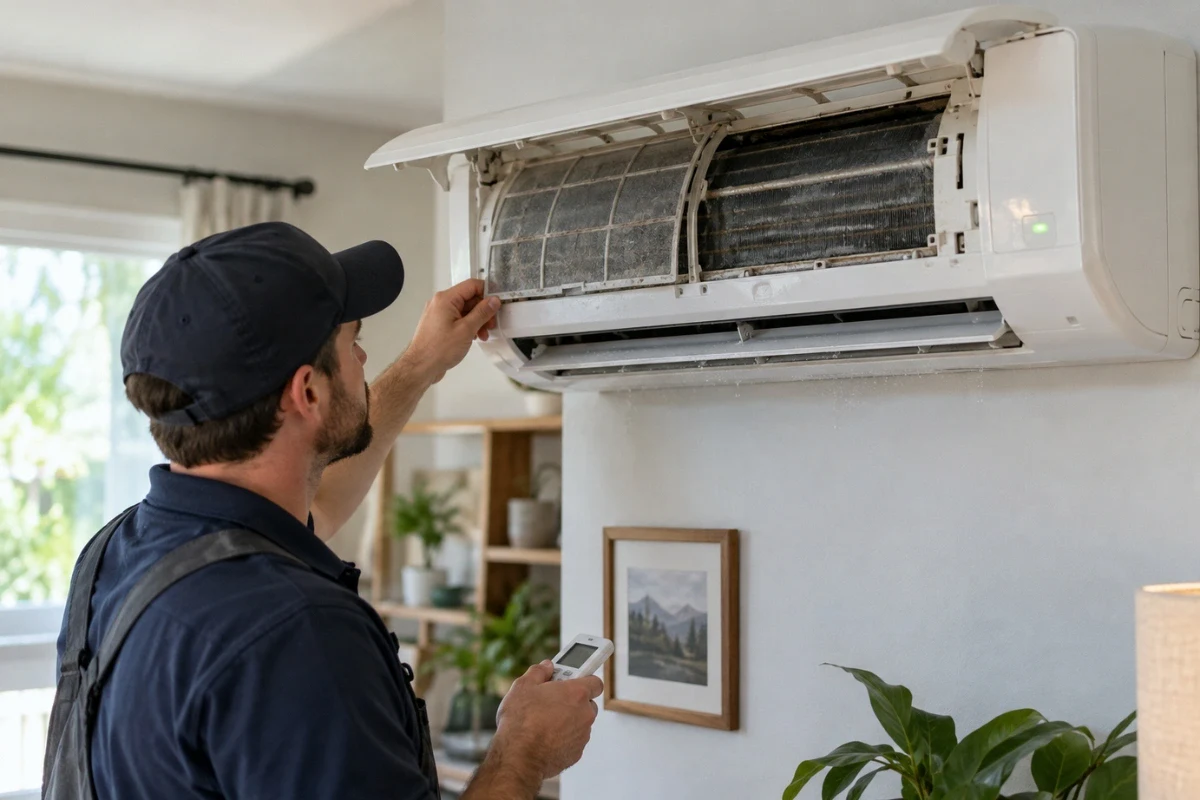
Check for a dirty air filter, and replace it if necessary. Also, make sure to check your registers and return air pathway for blockages. Closing air vents often suggests you can save energy by shutting off rooms, but this increases pressure and can lead to the very airflow issues.

A good airflow passes the cool air from the refrigeration cycle to you. A dirty air filter blocks that. Sometimes, we see issues with high MERV filters too.
A MERV 13+ filter traps even smaller particles. But the small air passage (which gets blocked easily) creates a significant filter pressure drop. If your blower motor can’t handle that level of static pressure, it will restrict the air flowing over the coil.
The problem doesn’t stop there. Restricted airflow is one of the reasons behind frozen AC coils. As a result, all of your cool air can’t enter the ductwork system.
That’s why Alternative Aire takes airflow obstruction extra seriously while suggesting an AC for your home.
The Nighttime Struggle: Why Your AC Fails After Sunset
If your AC works in the morning but struggles at night, it is mostly due to your home’s ability to shed heat and the rising moisture levels of where you live.
Attic Heat Gain and Thermal Lag
The attic heat gain/soak is when your attic absorbs massive amounts of energy during the day.
Even after the sun sets, the materials in your attic (and the air itself) can remain hot. This is the “thermal lag”. If your ductwork is also in the attic, the cool air from your AC gets reheated by that trapped heat.
This is why the air coming out of vents can feel cool, but your house can still be warm.
Why the Upstairs Stays Hot While the Downstairs Freezes
Besides the thermal lag we’ve mentioned, poor duct design and a lack of zoning can also be the reasons why your upstairs stays hot when the downstairs is cool.
It’s connected to physics and mechanical failure:
- The heat always rises above
- The return duct is in negative pressure, and it pulls in the attic air. (so you also never reach the humidity setpoint)
Plus, if your blower can’t push enough CFM per ton to the furthest bedrooms, you end up with a nighttime cooling failure where it matters most. This is why you need a proper Manual D duct sizing to balance it out during installation. Another solution is to go for a multi-zone system.
Why Your House Feels “Sticky” (The Sizing & Humidity Connection)
A latent heat removal failure is the main reason behind your home feeling sticky even at a cool temperature.
If your house feels sticky even at a cool temperature, you are likely experiencing a latent heat removal failure.
A functioning air conditioner has two jobs:
- Lowering the air temperature (sensible load)
- Removing moisture (latent load)
When these two are out of balance, the air feels “clammy” or “sticky” (even if your vents are blowing cold air).
Sensible vs. Latent Load: Why Cooling Isn’t Dehumidifying
To effectively remove the moisture, your evaporator coil should stay long enough to reach the dew point of the air passing over it.
In the evaporator coil, the humid air cools. The water vapor in it condenses into liquid form. You notice it dripping into the condensate drain line.
Sometimes, the air can move too quickly over the coil (measured in high CFM per ton). Without enough time to contact, the air can’t condense. The humidity returns indoors with the air.
Measure your airflow and make sure it is in the standard 400 CFM per ton range. Depending on where you live, the technicians can sometimes target 350 CFM per ton. That increases the dwell time on the coil.
The Curse of the Oversized Unit: Short-Cycling Explained
An oversized unit short-cycles and commonly causes high humidity.
In my experience, I’ve often seen people thinking “bigger is better”. They treat the size (tonnage) as efficiency (SEER). But a bigger unit also reaches the temperature setpoint fast. That means it shuts down quickly too.
As a result, your system never runs long enough for the dehumidification cycle to pull moisture out of the air.
If you notice your system turning on and off every 5 to 10 minutes, your humidity is most likely an oversized AC problem (which can also lead to an early compressor failure). A replacement is the only practical option here.
Technical Failures: When “Running” Doesn’t Mean “Working”
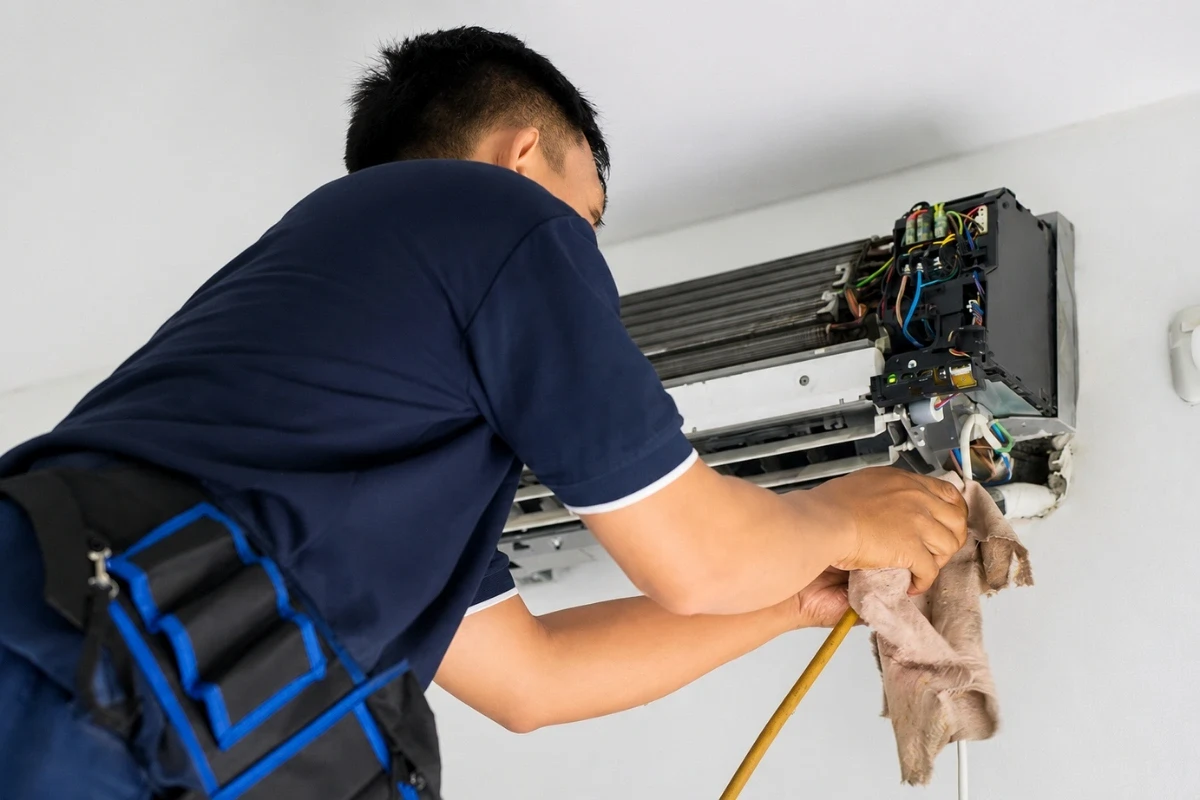
Technical failures (like refrigerant, compressor, and capacitor issues) can cause hot/warm air. You may hear the outdoor unit humming, but your AC can’t transfer heat properly. If you find yourself handling an AC emergency during a heatwave, knowing whether it is a mechanical or electrical failure is key.
Refrigerant Issues

Refrigerant carries the heat from inside to outside. If you have a refrigerant leak, the medium to carry the load gets low.
The easiest DIY way to identify low refrigerant is noticing icing on refrigerant lines (or the indoor A-coil). When levels are low, the refrigerant expands too much. The temperature drops too much below freezing, and the condensation turns into ice.
We always recommend getting professional help to deal with refrigerant issues. It is the best way to prevent AC breakdowns during a heatwave. They have the proper tools to charge your refrigerant levels precisely. Also, there are many more levels to it. For example, you need to measure superheat (to protect the compressor) and subcooling (to make sure the liquid line is full).
Mechanical Burnout: Compressors, Capacitors, and Contactors
The mechanical problems are connected to either cooling or blowing the cold air.
- If the internal valves of compressors fail, they can’t “pump” the air.
- A bad capacitor can’t start or run the motors
- A pitted or burnt contact in the contractor can’t send full voltage to the components
These issues can often cause the unit to vibrate or grind; checking for ways to reduce AC noise can sometimes lead you to discover these failing mechanical parts early.
All of them are linked to the AC not performing correctly. As a result, you can get weak cooling (and eventual motor burnout).
The Hidden Shutdown: Clogged Condensate Drain Lines
Sometimes the AC has just stopped working (although not seemingly) because your float switch or safety switch is preventing your AC from flooding your home.
Your condensate drain line has a condensate backup. Most modern systems have a safety switch to deal with too much standing water. Even though that is the case, the indoor blower fan will keep running. So the AC appears “on”, but the compressor is disabled by the switch.
Alternative Aire check the drain pan and the switch (a small T-shaped plastic device) to confirm. Clean the line with vinegar or get professional help to deal with the issue.
The “Leaky Bucket”: Building Envelope & Ductwork Issues
Often, your AC can run all night, but the house can stay hot simply because of leaks. I often use the “leaky bucket” analogy to explain homeowners. If you have holes in your bucket, it doesn’t matter how much water (cold air) you pour in; it will never stay full. This is exactly why you shouldn’t run AC with your windows open.
Return Duct Leaks: Pulling Humid Air from Attics and Crawl Spaces
Air leaks in the return duct (usually in the attic or crawl space) pull in more than just house air.
Negative pressure in the return plenum sucks in 120°F attic or damp crawl space moisture. The moisture easily bypasses your air filter. So, the evaporator coil has to work twice as hard to cool “outside” air. You can notice a massive evening performance drop.
A thermal imaging camera or a smoke pen is best to check the seams of your return plenum. Even small gaps can lead to significant infiltration loads. Sealing the seams and insulating your duct is your solution for leaks.
Measuring Success: The Supply vs. Return Temperature Split
How do you know if the air conditioner itself is actually doing its job? You check the temperature differential.
In a healthy system, the supply air temperature (the air coming out of the vent) should be 18°F to 21°F cooler than the return air temperature (the air being sucked into the intake).
If your split is only 10 degrees, you likely have a refrigerant undercharge or a dirty condenser coil. If the split is 25 degrees but the house is still hot, you likely have a restricted airflow issue or major duct leakage.
Professional Solutions: Sizing It Right with ACCA Standards
If you’ve performed the “Quick Checks” and your system is still failing, it’s time to look at the engineering behind the installation. True comfort is achieved through the ACCA (Air Conditioning Contractors of America) design protocols.
The Manual J, S, and D Advantage
Most “rule of thumb” contractors size systems based on square footage alone. It is a recipe for short-cycling or undersizing.
- Manual J (Load Calculation): This is a room-by-room analysis that factors in windows, insulation, and thermal barriers. It tells you exactly how much BTUh your home needs.
- Manual S (Equipment Selection): This ensures the unit selected can actually meet the latent vs. sensible load requirements calculated in Manual J.
- Manual D (Duct Design): This calculates external static pressure to ensure the ductwork is large enough to move the required CFM per ton without noise or restricted airflow.
Whole-Home Dehumidification vs. Variable Speed Technology
For homes in high-humidity climates, the AC unit alone may not be enough. It is especially true during the “shoulder seasons” (when it’s humid but not hot enough for the AC to run).

- Variable-Speed Blower: An ECM blower motor can slow down to increase moisture removal on the coil without over-cooling the home.
- Whole-Home Dehumidifier: You can use an integrated unit that works with your HVAC to maintain a strict humidity setpoint (usually 45–50%) regardless of the cooling cycle.
- ERV (Energy Recovery Ventilator): In modern, airtight homes, an ERV can provide fresh air ventilation without bringing in the full moisture load of the outdoors.
Conclusion
Diagnosing an air conditioner that runs without cooling requires looking beyond the thermostat. Some DIY maintenance can give you immediate comfort, especially those that worsen at night. So check your dirty air filter and clear the clogged condensate drain line. Always call a professional to assist you with other symptom checks.
True home comfort relies on a system balanced by ACCA Manual J, S, and D standards. If your quick checks aren’t dropping the temperature, consult a professional to make sure your system is accurately sized and sealed for maximum efficiency.
Frequently Asked Questions (FAQs)
Should I turn off the AC if it’s not cooling?
Yes, turning off the AC is the logical and safest choice. Continuing to run a malfunctioning AC can strain your compressor and other components more. You can end up with more severe and costly repairs later.
Is my unit oversized if it short-cycles?
Yes. If your unit turns off in under 10 minutes but the house feels “clammy,” it is likely oversized and failing to run a proper dehumidification cycle.
How do I measure static pressure?
This requires a manometer and a professional technician. High static pressure (often from a high MERV filter) can kill your blower motor and freeze your coils.
Does cleaning the AC filter make it colder?
If your warm air problem is from your filter, then cleaning it will make it colder. However, you should clean/change it either way if you haven’t already for long enough.
Why does my AC only work on high?
It could be due to problems with your blower motor or the fan speed control. If those parts malfunction, your system operates at full speed.
Why does my AC take so long to get cold?
Several factors can be behind a slow cooling process. The most common is the dirty or clogged filter. Low refrigerant levels, wrong size, and poor insulation can also slow down the cooling process.