High indoor humidity makes your Durham home feel sticky at night. This happens because relative humidity RH spikes as temperatures drop after sunset. You may notice window condensation even if your thermostat shows a cool temperature.
These issues often stem from an oversized air conditioner, duct leaks, or high outdoor dew points. Maintaining an indoor humidity 30 to 50 percent range is the best way to ensure comfort. If your system struggles, a professional from Alternative Aire can fix the mold growth risk.
But how can you find out the real cause and what to tell the technicuous? This guide will tell you everything you need to know.
|
TL;DR: Durham homes feel sticky at night because dropping temperatures cause relative humidity to spike, while AC units often short-cycle and fail to remove enough moisture. To fix this, maintain an indoor humidity level between 30% and 50% by setting your thermostat fan to AUTO, sealing leaky ducts, and addressing damp crawl spaces. For long-term comfort and to prevent mold growth risk, consider a whole-home dehumidifier to manage the heavy latent load common in the North Carolina Piedmont. |
Why Homes in Durham Feel More Humid After Sunset?
Homes in the North Carolina Piedmont face a unique challenge with evening moisture. The National Weather Service Raleigh/Durham notes that as temperatures drop, the air’s ability to hold water decreases.
This causes the relative humidity RH to rise sharply even if the total water in the air stays the same. The dew point overnight tells the true story of how the air feels.
The NOAA tracks these humidity spikes overnight across the region. When the sun goes down, your AC does not have to work as hard to combat the heat. This means the unit runs for shorter periods.
Since the AC only removes water while running, moisture remains trapped inside. This is why humidity is worse at night than during the day.
Without the sun’s heat, your thermostat responds quickly. Your home stays cool, but the air remains saturated with water. To keep air moving and dry, never keep windows open while your system is active, as this introduces a fresh moisture influx that the short-cycling unit cannot handle.
8 Reasons Your House Feels Sticky at Night (With Fixes)
Discover why your home feels sticky at night and learn how to fix moisture issues for better sleep. Stop the nighttime mugginess with these nine causes and expert solutions for a drier home.
1. High Dew Point Overnight Is Raising Indoor Humidity
The dew point makes the air feel sticky because it measures the actual amount of moisture in the air. In Durham, NC, the dew point often stays in the 70s during summer nights.

This creates a high latent humidity load that seeps into your house through small gaps. Your AC must work very hard to process this heavy, sticky air at night.
High relative humidity RH outside translates to higher pressure pushing moisture indoors. Even a well-built home experiences some infiltration of this damp air. You might notice that your house feels muggy after sunset more than during the peak heat of the day.
This happens because the outdoor air’s humidity ratio is much higher than your desired indoor levels. If your humidity issues are accompanied by a cooling failure, you need a technician who can provide a same day response during a heat spike.
Fix: Monitor Dew Point and Maintain 30–50% Indoor Humidity
You should aim for an ideal indoor humidity 30 to 50 percent range for maximum comfort. Buy a simple hygrometer to track your indoor humidity 30 to 50 percent daily.
If you ask, “is 70% humidity too high for a house?” The answer is yes.
At that level, you risk mold growth and significant discomfort. Does 70% humidity feel sticky? Most people find it unbearable for sleep.
| Humidity Level | Comfort Rating | Risk Level |
| 30% – 45% | Excellent | Very Low |
| 46% – 55% | Good | Low |
| 56% – 65% | Sticky | Moderate |
| Above 66% | Very Muggy | High (Mold Risk) |
2. Your AC Is Cooling but Not Removing Moisture
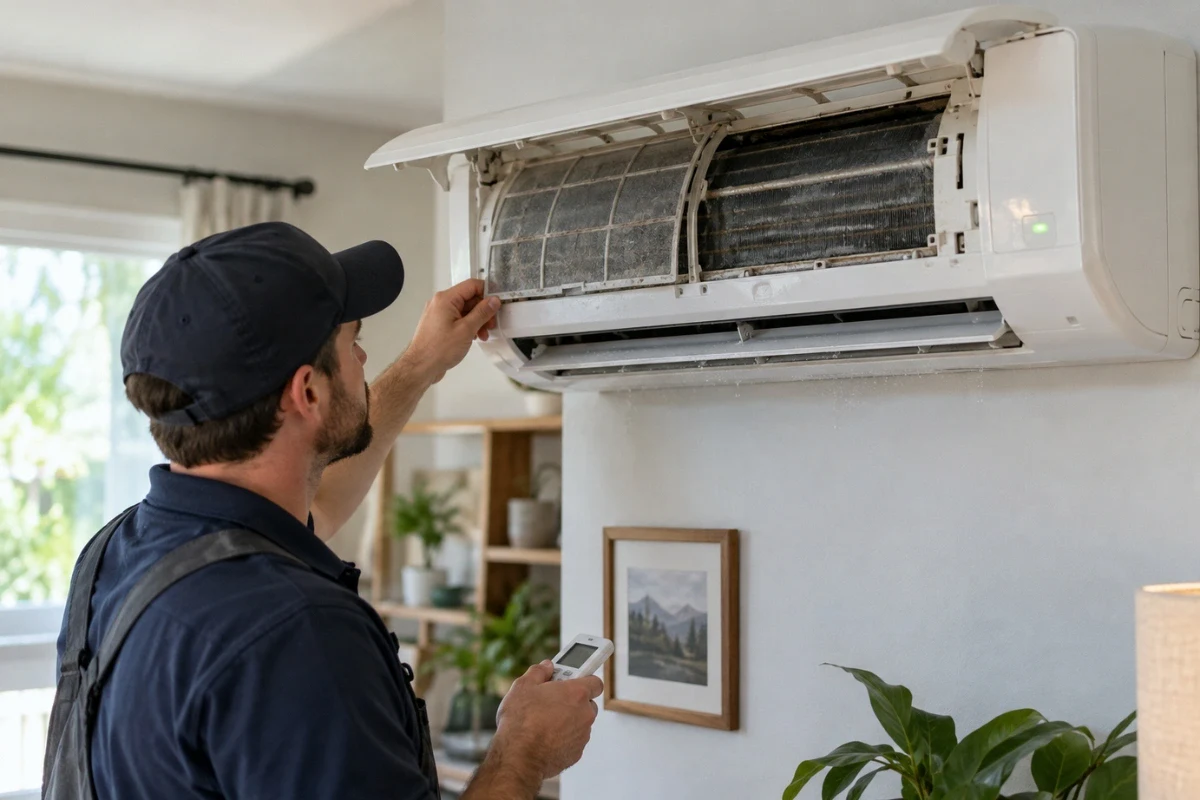
Sometimes your AC is running but the house still feels humid despite the cool air. This occurs when the AC cools but does not remove humidity effectively. A common cause is a dirty evaporator coil which cannot absorb moisture well. Also, a clogged condensate drain line can back up and keep moisture near the airflow.
You might feel that it is normal for AC to feel clammy at night, but it is not. A healthy system should provide excellent AC dehumidification as it lowers the temperature. If your thermostat says 72 but it feels damp, your unit is failing its primary secondary job. This sensible cooling without latent cooling is a sign of a mechanical issue.
Fix: Improve Dehumidification Performance
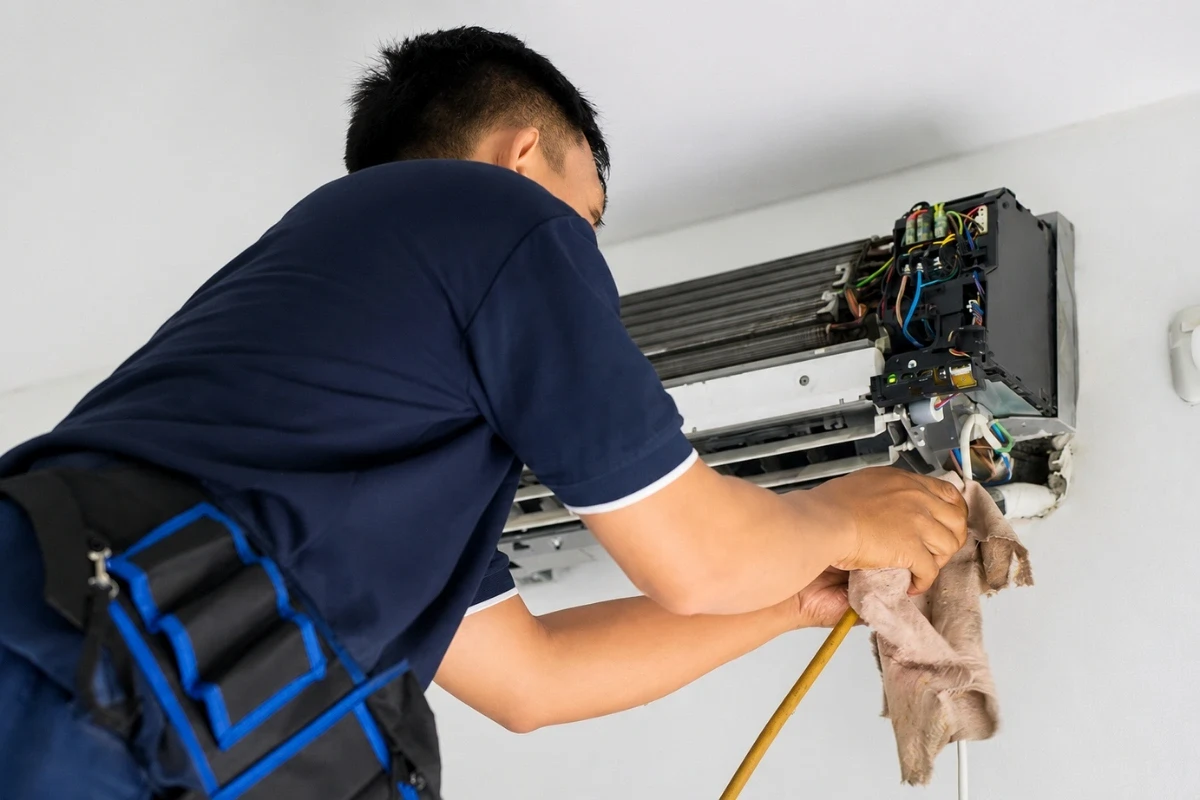
You should clean drain line paths regularly to ensure water exits your home properly. Ask a technician to inspect evaporator coil surfaces for dirt or ice buildup. Sometimes, you can lower blower speed for dehumidification to allow the air more time on the cold coil. A professional AC inspection is the best way to verify your system is tuned for the North Carolina Piedmont climate.
3. Your AC Is Oversized and Short Cycling
An oversized air conditioner is a major cause of high humidity in Durham, NC. When a unit is too big, it cools the house very fast and then shuts off. This is called short cycling. Because the system stops so quickly, it does not have enough time to pull water out of the air.

AC short cycling causes high humidity because moisture removal only happens during long run times. It can cause discomfort at night, even at 72 degrees. Oversized AC humidity problems are common in newer homes with tight construction.
If your system is short-cycling, humidity will remain high even if the room feels like an icebox. You are essentially paying for a powerful machine that ignores the latent load.
Fix: Proper System Sizing and Variable-Speed Upgrade
You need a professional Manual load calculation to ensure your system fits your home’s specific needs. A variable-speed system humidity control feature is an excellent upgrade for this problem. These systems run at lower speeds for longer periods.
This allows them to remove massive amounts of water while using less energy. This is a great solution for repeat AC breakdowns during heat waves caused by system stress.
4. Thermostat Fan Is Set to ON Instead of AUTO
Many people ask, should I run the AC fan on auto or on to reduce humidity? The answer is always AUTO.
If you set the blower fan setting auto vs on to “ON,” the fan runs even when the compressor is off. This blows the water sitting on the evaporator coil right back into your living space.
The thermostat fan auto vs on humidity choice determines if you re-evaporate moisture. When the cooling cycle ends, the coil is dripping wet.
If the fan keeps blowing, that water turns back into vapor. This causes the humidity to spike the moment the AC stops cooling. It can also cause ice to build up around ac. You should only use the “ON” setting if you have high-end air filtration needs and a dedicated dehumidifier.
Fix: Set Fan to AUTO and Adjust Airflow
Check your thermostat right now and ensure it is set to AUTO. This simple change can lower your indoor RH by 5% to 10% overnight. You can also talk to a pro about the best blower speed for dehumidification for your specific model. Modern thermostats often have a “Circulate” mode that is better than the “ON” setting.
5. Crawl Space Moisture Is Entering Your Living Area
In the Research Triangle, many homes have open crawl spaces that hold wet air. This crawl space moisture travels upward through the floor and into your rooms. This process is called the stack effect.
A crawl space with high humidity, causing sticky house issues, is very common in older Durham neighborhoods like Trinity Park.
If you do not have a crawl space vapor barrier, the dirt floor releases gallons of water daily. This crawl space causing high humidity in the house can make your first floor feel significantly more muggy than the second floor.
Over time, this moisture can rot your floor joists and cause expensive damage. It also invites pests that love damp, dark environments.
Fix: Encapsulation and Crawl Space Dehumidification
Installing a thick vapor barrier is the first step to a dry home. For the best results, you should consider full encapsulation with a dedicated crawl-space dehumidifier. This completely seals the space from outside elements. It turns your crawl space into a clean, dry area that helps reduce humidity throughout your whole house.
6. Duct Leaks Are Pulling Humid Night Air Inside
Your ductwork might have cracks or loose joints that allow outdoor air to enter. Duct leaks pulling humid air into the house occur when the return air leak is in an unconditioned space like an attic. This is called infiltration. This pulls in hot, wet air and mixes it with your clean, cool air.

A return-side leak is especially bad because it creates a massive latent humidity load on the AC before the air even hits the coil. This duct leakage makes the system work twice as hard for half the comfort.
You might notice dust near your vents or a musty odor when the air starts moving. This is a common issue that causes an AC to run but not cool at night.
Fix: Seal Return Ducts and Balance Air Pressure
Professional duct pressure testing can find exactly where your system is losing air. You should invest in air sealing and ventilation improvements to keep the damp Durham air outside. Sealing ducts with mastic or high-quality foil tape is a very cost-effective fix. It improves your indoor air quality IAQ and lowers your monthly power bills.
7. Bathroom and Kitchen Ventilation Is Not Removing Moisture
Daily activities like showering or cooking add massive amounts of water to your air. If your bathroom fan is not venting outside, or if the humidity is weak, the steam stays in your house.
A bathroom exhaust fan must move air all the way out of the roof or wall. Many fans just blow the wet air into the attic, which is a major mistake.
If you wonder, why does the bathroom stay damp forever?
Your fan might be the wrong size. A kitchen range hood vented outside is also vital for removing steam from boiling water. If these fans are not working, you are essentially adding a latent load that your AC was not designed to handle.
This moisture often migrates to the bedrooms, where it makes sleeping difficult. Poor window and vent habits like these often allow moisture to migrate into bedrooms, making sleep difficult.
Fix: Proper Exterior Venting and Timed Exhaust Controls
Ensure all your exhaust fans vent directly to the outdoors. You can install timed switches that keep the fan running for 20 minutes after your shower. This ensures all the moisture is removed from the room. High-quality fans are much quieter and more efficient than the basic models found in most homes.
8. Attic Humidity and Poor Air Sealing Are Trapping Moisture

High attic humidity can push downward into your living space through light fixtures and top plates. Without proper air sealing, your ceiling acts like a giant sieve for moist air. This causes window sweat at night, weird AC noise, and window condensation on the upper floors of your home.
Many homes lack a proper fresh air intake or enough soffit vents to keep the attic dry. When heat and moisture get trapped in the attic, it creates a pressure cooker effect.
This moisture eventually seeps through small gaps in your drywall. Improving your air sealing is one of the best ways to combat a musty smell at night with high humidity.
Fix: Improve Insulation, Air Sealing, and Ventilation Design
You should hire a pro to seal all penetrations between your attic and your home. This includes recessed lights, plumbing stacks, and wire holes. Adding more attic ventilation can also help flush out the moisture before it migrates. Proper air sealing makes your home more comfortable and much easier to dehumidify.
What Is the Ideal Indoor Humidity for Durham Homes?
The EPA recommends an indoor humidity range of 30 to 50 percent for healthy living. In Durham, NC, staying at the lower end of this range (around 45%) feels the best. The best indoor humidity level in North Carolina prevents the growth of allergens. It also keeps your home smelling fresh and clean.
High humidity is bad for sleep because it makes the air feel heavy. When the RH is over 60%, your body struggles to release heat. Lower humidity also controls the dust mites’ humidity level. These microscopic pests thrive in air above 50% RH. Keeping your air dry significantly reduces their population and helps with allergies.
Final Thought
If you have tried the quick fixes and your home still feels muggy, it is time for a professional. Persistent AC not dehumidifying issues usually indicate a mechanical problem. A specialist from Alternative Aire can perform indoor air quality IAQ testing to find the exact source of your discomfort.
We often see short cycling humidity issues that require a system adjustment or an upgrade. If you are interested in a whole-home dehumidifier installation in Durham, NC, our team can help. Don’t ignore the musty smell caused by high humidity.
If you need a same-day response during heat spikes and how to triage appointments, reach out to our team immediately.
Frequently Asked Questions
Why does my house feel sticky at night?
Your house feels sticky because the relative humidity RH spikes as the outdoor temperature drops. Your AC also runs less often at night, which means it removes less moisture. This leaves the air feeling saturated and clammy.
Does 70% humidity feel sticky?
Yes, 70% humidity feels very sticky and uncomfortable for most people. At this level, your sweat cannot evaporate from your skin. This leads to a tacky, overheated feeling that makes it impossible to sleep well.
Is 70% humidity too high for a house?
Yes, 70% humidity is too high for any home. The EPA states that levels above 60% can trigger mold growth risk and dust mite infestations. You should aim for a range between 30% and 50% for health and safety.
How to lower indoor humidity fast at night?
To lower humidity fast, set your thermostat to “Cool” and the fan to “AUTO.” Lower the temperature by a few degrees to trigger a long cooling cycle. Run all exhaust fans to pull moist air out of the house.
Why do my windows sweat at night?
Windows sweat at night because warm, moist air inside the house hits the cold glass surface. This causes the water vapor to turn into liquid window condensation. This is a major sign that your indoor RH is too high.
Is it normal for humidity to rise overnight in Durham?
Yes, it is normal for outdoor humidity to rise as the temperature drops toward the dew point. However, it is not normal for your indoor humidity to exceed 50%. Your HVAC system should maintain a dry environment.