You expect your AC to handle a Durham summer. But every heat wave, it breaks down again. The house feels heavy. The air feels warm. And you wonder why this keeps happening.
I see this problem in Durham homes every year. Most repeat breakdowns do not happen by accident. They come from sizing mistakes or airflow problems that no one fixed the first time.
In this guide, you will learn why your AC fails during extreme heat and how to solve the real root cause for good.

|
TL;DR Usually, poor sizing or airflow are the reasons behind repeated breakdowns during heatwaves; finding and stopping the root cause is the solution, rather than just replacing broken parts. |
Why Do AC Systems Struggle During Durham Heat Waves?
Air conditioners are designed for specific operating limits. When outdoor temperatures stay above 95°F for extended periods, the system runs close to its maximum capacity, and that’s why it fails most of the time.
Under normal conditions, your AC cycles on and off. During prolonged heat, it may run continuously. If there are underlying weaknesses, high temperatures expose them quickly.
Let’s look at what happens inside the system.
Extended Runtime and Compressor Overheating
The compressor is the core of your air conditioning system. In mild weather, it cycles throughout the day. These rest periods allow internal components to cool down and stabilize.
When temperatures stay elevated for days at a time, the unit may run for hours without reaching the thermostat setting. Extended operation increases internal temperature and accelerates component wear.
As heat builds inside the system:
- Refrigerant pressure rises
- Lubricating oil becomes thinner
- Internal motor parts operate at higher temperatures
Over time, this constant stress weakens the compressor’s internal components. You may notice the AC running but not cooling, shutting off unexpectedly, or struggling to restart, especially at night. In severe cases, the compressor can fail completely.
High Outdoor Temperatures Reduce the Release of Heat Outdoors
Your outdoor unit does not create cold air. It removes heat from inside your home and releases it outdoors.
When outside air is extremely hot, the condenser coil cannot release indoor heat as efficiently. As a result, system pressure increases and cooling output declines.
This leads to:
- Reduced cooling performance
- Longer operating cycles
- Increased wear on internal components
If the outdoor unit sits in direct sun or has restricted airflow due to debris, blocked fins, or tight installation spacing, heat removal becomes even less efficient.
Electrical Stress and Component Failure
Capacitors, which help start the compressor and fan motors, are especially sensitive to heat. Prolonged exposure can weaken their internal structure. Once degraded, they may fail without warning.
During peak summer demand, power surges increase operating stress on aging components. When this happens, you may hear a humming sound from the unit without it starting, or the breaker may trip repeatedly.
In many cases, the system itself has not completely failed. A single overheated electrical component may be the real cause.
How Does Incorrect AC Sizing Lead to Breakdowns?
Incorrect sizing creates an imbalance inside a cooling system. During mild weather, that imbalance may not be obvious. During extended heat waves, it becomes clear.

At Alternative Aire, we have seen many Durham homes where the AC worked “okay” for years. Then one intense summer exposes the weakness. The equipment was never matched correctly to the home’s cooling demand.
Proper AC sizing requires a load calculation that matches equipment capacity to your home’s actual cooling demand. When that balance is off, system lifespan drops.
Let’s look at the difference.
What Happens When an AC System Is Undersized?
An undersized system does not have enough capacity to handle peak cooling demand.
Common signs include:
- The thermostat never reaches the set temperature
- Indoor temperatures stay several degrees higher
- The system runs for extended periods without shutting off
For example, the thermostat may be set to 72°F, but the home remains at 78°F. The unit continues operating, but never stabilizes the space.
This continuous operation increases strain on the compressor and blower motor. Over time, internal components wear down faster. Summer failures become more frequent.
An undersized system does not break because it is defective. It breaks because it is constantly pushed beyond its intended capacity.
What Happens When an AC System Is Oversized?
An oversized system cools the air too quickly and shuts off before completing a full cycle. This is known as short cycling.
Short cycling can cause:
- Uneven temperatures between rooms
- Inadequate humidity removal
- Increased wear from frequent starts
Because the system shuts down early, it does not run long enough to remove sufficient moisture from the air. The temperature may read 72°F, but the indoor air can still feel damp or heavy. At night, this issue becomes more noticeable, and your home feels sticky.
When moisture remains trapped indoors, comfort declines even if the thermostat setting stays low. This makes it harder to reduce the latent load, which is essential for proper humidity control and consistent comfort after sunset. Persistent short cycling also increases electrical and mechanical stress due to repeated start-ups.
Under sustained summer load, that repeated strain shortens equipment lifespan faster than most homeowners realize.
Why Does Rule-of-Thumb Sizing Fail?
Some installations rely on rough estimates based on square footage. This method ignores how homes actually gain and retain heat.
Two houses with identical square footage can require very different cooling capacities depending on:
- Insulation levels
- Window orientation and efficiency
- Roof exposure to sunlight
- Air leakage
- Ceiling height
- Duct condition
Without a proper load calculation, equipment size becomes guesswork. High summer temperatures quickly reveal when that estimate was incorrect.
What Are the Signs Your AC Was Never Properly Sized?
Sizing problems usually show up as recurring performance patterns.
Watch for:
- Extended runtime during hot afternoons
- Uneven room temperatures
- Ongoing indoor humidity issues
- Rising seasonal energy bills
- Difficulty maintaining temperature during peak heat
These issues are also repetitive because of installation problems.
Replacing individual components may restore temporary operation, but does not fix a design mismatch. If your system struggles every summer, a professional HVAC service for airflow testing and load calculation can determine whether the issue is mechanical, helping you avoid repeated repair costs.
How Do Airflow Restrictions Cause AC Failure?
Airflow restrictions reduce cooling efficiency and increase internal load. Even properly sized systems rely on steady air movement.
The system must pull warm air in, cool it, and push it back into your home. When airflow slows, components operate under greater mechanical demand.
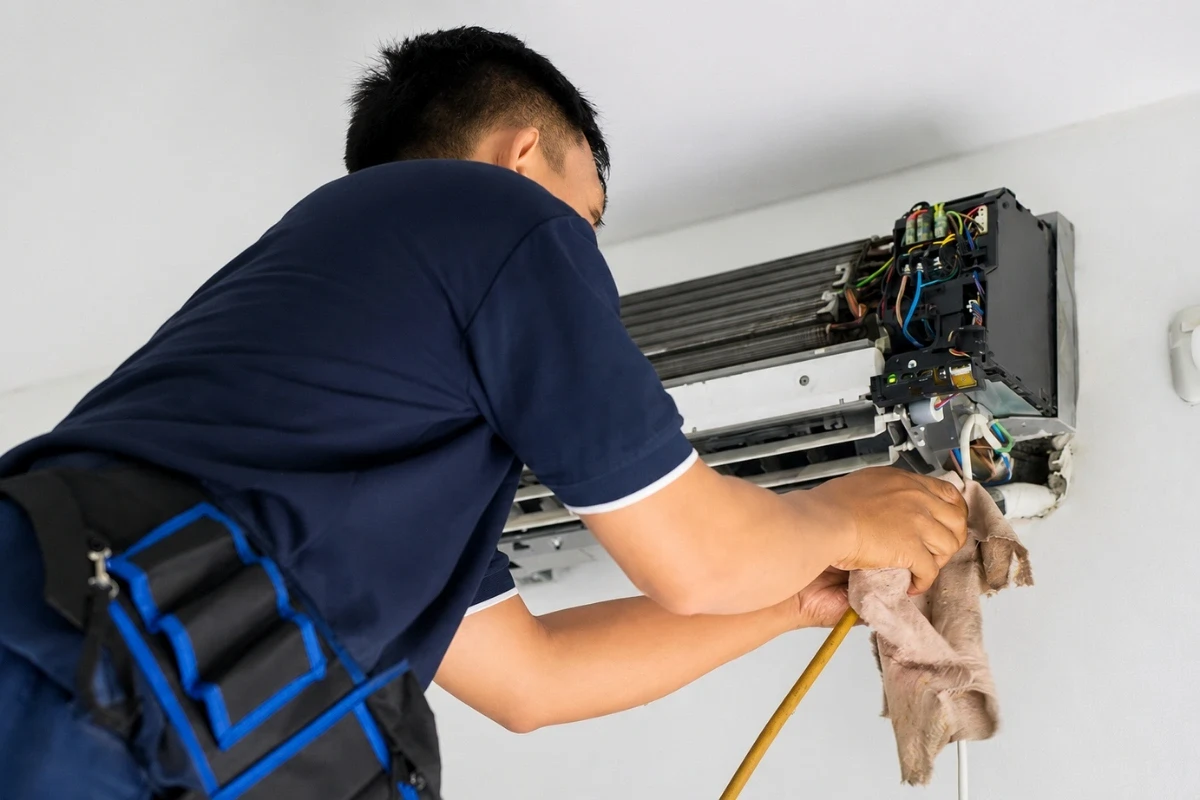
I often see homeowners replace capacitors, add refrigerant, or swap parts. But the real issue sits inside the ductwork or around the coils. Let’s break down where airflow usually fails.
How Do Dirty Coils Affect Performance?
Dirty coils reduce heat transfer efficiency. The indoor coil absorbs heat. The outdoor coil releases it.
Inside coil problems often cause:
- Weak airflow from vents
- Ice buildup on refrigerant lines
- Reduced cooling output
Outside coil blockage causes:
- Higher system pressure
- Overheating
- Sudden shutdown during peak heat
Even a slightly dirty coil can cause the system to fail. If you’ve ever noticed AC freezing up after humid weather, it is often due to airflow restrictions.
Clean airflow keeps pressures stable. Restricted airflow raises stress.
Ductwork Restrictions and Static Pressure Problems

Your duct system distributes conditioned air throughout the home. If ducts are undersized, crushed, leaking, or poorly configured, airflow becomes uneven.
When air cannot move freely, pressure builds inside the system. This condition is known as high static pressure. Most homeowners have never heard the term “static pressure,” yet improper static pressure is one of the most common hidden causes of premature system failure.
High static pressure can result in:
- Noticeable airflow noise
- Weak output from certain vents
- Reduced cooling capacity
- Increased strain on blower components
In many homes, new equipment is installed without redesigning older duct systems. If the ductwork cannot support the required airflow, performance suffers regardless of equipment quality.
Often, the system is blamed when the duct design is the limiting factor.
Return Air Design and Pressure Imbalance
If return vents are undersized, blocked, or concentrated in one area, the system struggles to draw air back efficiently. Closed bedroom doors can also create pressure differences between rooms.
When return airflow is restricted:
- Cooling becomes inconsistent
- Air circulation weakens
- Mechanical strain increases
Many homeowners try to save energy by closing vents in unused rooms, but that can actually hurt the home’s dehumidification and put extra strain on the system.
Restricted airflow prevents the AC from removing moisture efficiently, causing higher indoor humidity and potential coil issues.
Many homeowners also underestimate how window and vent habits impact comfort; closing vents in unused rooms may seem efficient, but it can increase pressure imbalance and mechanical load on the system.
How High Static Pressure Damages Blower Motors
Modern systems often use variable-speed blower motors that automatically adjust to maintain airflow.
When static pressure is high, the motor works harder to maintain airflow. Over time, this extra operating load can shorten its lifespan. Before failure occurs, you may notice:
- Whistling vents
- Rattling ductwork
- Louder-than-normal airflow
These sounds often indicate airflow resistance rather than a defective motor. It is the same type of air conditioner noise that many homeowners try to eliminate without realizing it signals deeper airflow problems.
Blower motor failure during peak summer conditions is rarely sudden; it typically develops from a prolonged airflow imbalance. Airflow problems do not resolve on their own; proper testing and measurement are required to identify and correct the restriction.
What Should You Do When Your AC Breaks Down During a Heat Wave?
When your AC stops during a Durham heat wave, stay calm and check the basics first. Many shutdowns happen because a safety component is protecting the system from serious damage.
Before assuming major failure, confirm airflow and power. Small issues often look like expensive breakdowns. Many homeowners schedule emergency repair visits during extreme heat, only to discover the problem was minor. And during a Durham heat wave, waiting even one day without cooling can feel unbearable.
Let’s walk through what to check first.
What Immediate Checks Should You Do Before Calling for Service?
Start simple. Many “emergencies” come down to airflow or electrical interruptions.
1. Check the thermostat.
Make sure it is set to “cool.” Confirm the set temperature is lower than the current room temperature. Replace batteries if the display looks weak or blank.
2. Check the breaker panel.
If the breaker has tripped, reset it once. If it trips again, stop there. Repeated tripping usually signals an electrical issue that needs professional diagnosis.
3. Inspect the air filter.
A clogged filter restricts airflow and can trigger a safety shutdown. If it looks dirty, replace it immediately.
4. Look at the outdoor unit.
Clear away leaves, grass clippings, and debris around the condenser. Make sure there is open space on all sides for proper airflow.
If the outdoor unit hums but does not start, a failed capacitor may be the cause. Do not open the cabinet yourself. Capacitors store electrical charge even when the system is off.
These checks eliminate the most common airflow and power issues quickly and safely.
How Can You Reduce System Stress While Waiting for Service?
If cooling is weak but still running, your goal is to reduce indoor heat gain and protect the equipment until help arrives.
You can:
- Raise the thermostat slightly to reduce non-stop running
- Avoid using ovens, dryers, and other heat-producing appliances during peak afternoon hours
- Close blinds and curtains on sun-facing windows
- Use ceiling fans to improve air circulation and comfort
- Keep exterior doors and windows fully closed
These steps lower the cooling load inside your home. They do not solve mechanical problems. But they prevent additional strain during extreme heat.
How Do You Permanently Stop Repeat Summer Breakdowns and Decide Whether to Repair or Replace?
If your AC fails during every Durham heat wave, the problem is usually in the design or installation. Quick repairs restore cooling. They rarely fix the root cause.
Permanent reliability requires measurement, airflow correction, and a cost-based decision about long-term performance.
For example, we evaluated a Durham home that had replaced its compressor twice in four years. Each time, the system failed during the peak July heat. Testing showed high static pressure caused by undersized return ductwork. Once the duct system was corrected and airflow stabilized, the unit stopped overheating, and no further summer failures occurred. The equipment was not defective. The design was.

Here is how to evaluate both.
Step 1: Confirm Proper System Sizing
Ensure your AC is correctly sized. A professional load calculation reviews insulation, windows, air leaks, ceiling height, and Durham’s climate. Oversized units short cycle; undersized units run nonstop. Correct sizing balances cooling and performance.
Step 2: Test Airflow and Static Pressure
Even the right-sized unit fails if airflow is restricted. Professionals measure total airflow, duct static pressure, and return/supply balance. High pressure stresses components and reduces cooling efficiency.
Step 3: Determine If Duct Modifications Can Solve the Problem
Duct issues often cause failures. Solutions include enlarging return ducts, adding vents, replacing crushed or undersized sections, and sealing leaks. Balanced airflow stabilizes cycles and reduces internal strain.
Step 4: Evaluate Repair History and Total Cost
Review past repairs and spending. Ask how often failures occurred, if reliability improved, and whether emergency costs exceed planned replacement. Temporary fixes can cost more over time. If you’ve invested in multiple summer repairs without improved reliability, the question shifts from “Can it be fixed?” to “Should it keep being fixed?” That distinction matters financially.
Step 5: Check for Energy Waste and Comfort Instability
Long runtimes, rising bills, uneven cooling, and sticky air indicate design issues. Correct sizing and airflow reduce energy use and stabilize indoor comfort.
Step 6: When Replacement Becomes the Smarter Investment
Replace when repeated failures, age, and inefficiency combine. Justified if the system is 10–12+ years old, major components have failed, or comfort is inconsistent. Modern variable-speed systems work best with proper design corrections.
Conclusion
If your AC keeps failing during Durham heat waves, the issue is rarely just the weather. Repeated breakdowns usually point to sizing errors or airflow restrictions that were never corrected. Lasting reliability comes from proper load calculation, duct evaluation, and measured airflow testing.
If your AC keeps failing every summer, stop paying for temporary fixes. At Alternative Aire, we measure static pressure, test total airflow, and perform proper load calculations before recommending repair or replacement. You get real numbers, not assumptions, so you can make a confident decision that stops repeat breakdowns instead of paying for the same repair twice.
FAQ
Why does low refrigerant cause AC failure during heat waves?
Low refrigerant makes your AC run longer and hotter during extreme heat.
When refrigerant levels drop, the system cannot absorb and release heat properly. The compressor works harder, pressure rises, and cooling weakens. Common signs include ice buildup, warm airflow, and higher energy bills.
How can an aging AC system lead to repeated summer breakdowns?
Older AC systems struggle during peak summer heat because internal parts lose efficiency over time.
Compressors wear down, electrical components weaken, and the unit runs longer to maintain temperature. If breakdowns happen every summer, age combined with design issues may make replacement more reliable than repeated repairs.
Can duct leaks cause AC failure during extreme heat?
Yes, duct leaks can cause AC failure during extreme heat.
Leaking ducts lose cooled air into attics or crawlspaces, reducing airflow inside the home. The system runs longer to compensate, increasing wear on motors and the compressor.
Why does high indoor humidity increase AC strain?
High indoor humidity forces your AC to work harder to remove both heat and moisture.
If airflow is restricted or the unit short-cycles, humidity stays trapped inside. The system runs longer without improving comfort, increasing the internal workload.
How do voltage fluctuations affect AC reliability in summer?
Voltage fluctuations can damage AC components during peak summer demand.
Spikes and dips stress capacitors and compressors, especially in older systems. Repeated electrical stress can cause sudden shutdowns or starting problems.
Does outdoor condenser placement impact performance?
Yes, poor condenser placement reduces AC efficiency during hot weather.
Blocked airflow, tight clearances, or direct sun exposure increase operating pressure. Keeping at least 2–3 feet of clearance and clean coils helps maintain stable performance.