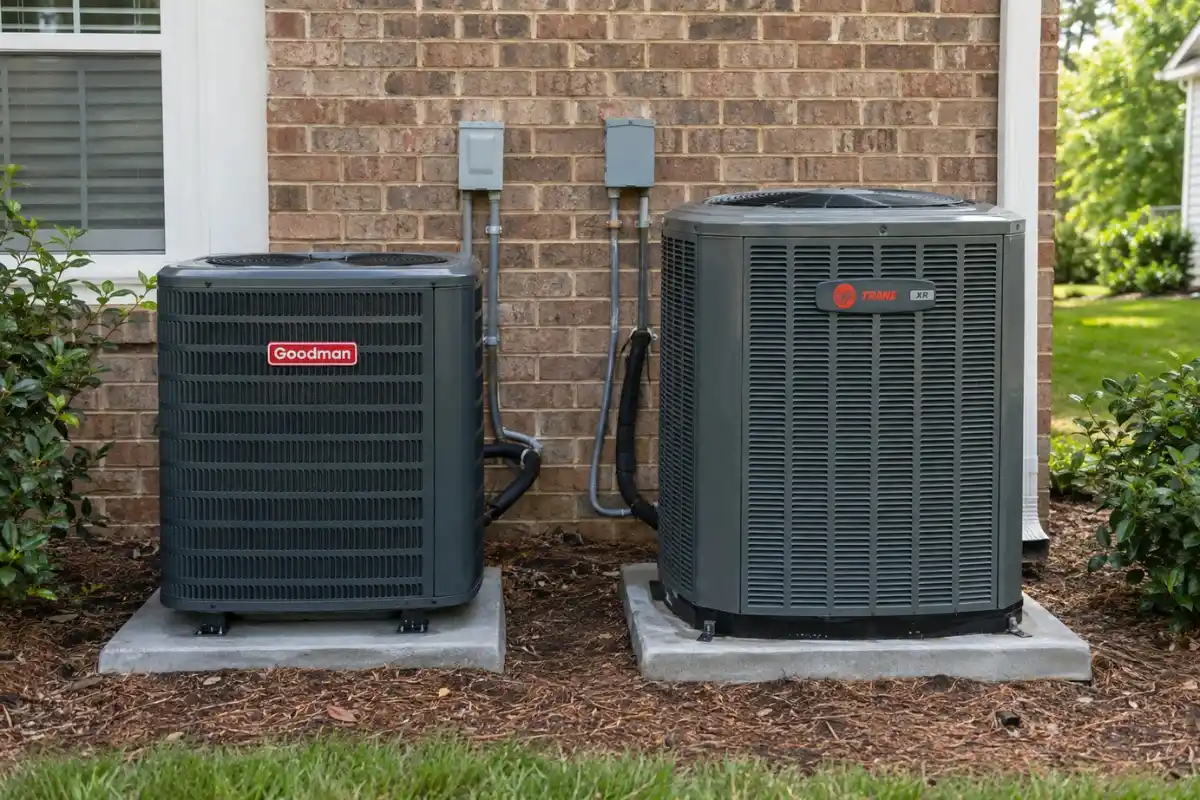
Goodman usually wins on upfront price, while Trane makes more sense when you’re willing to spend more for higher-end comfort, efficiency, and long-term ownership.
That doesn’t automatically make Goodman the better buy, or Trane the better machine.
Homeowners often make this comparison harder than it needs to be. A basic Goodman and a premium Trane are not really the same type of system.
Goodman focuses more on upfront value. Trane focuses more on premium comfort, efficiency, and long-term performance. So the better choice depends on what you actually want from your AC.
How Much Does an AC Cost in Durham, NC?
Before comparing Goodman and Trane, it helps to know what homeowners are paying locally.
One 2026 Durham cost estimate puts a typical central AC installation between $5,650 and $12,000, with a midpoint around $8,850. That includes the condenser, evaporator coil, and standard installation labor.
Treat that as a local benchmark, not a quote.
A straightforward 3-ton changeout can land near the lower end. Start adding a high-efficiency inverter system, communicating controls, duct repairs, electrical work, a new air handler, or difficult access, and the number moves quickly.
Labor is not unusually expensive here, either. Current wage data shows a median wage of $28.45 per hour for HVAC mechanics and installers in Durham–Chapel Hill, compared with $29.33 nationally.
That doesn’t mean your HVAC contractor in Durham charges $28.45 an hour. Business overhead, trucks, insurance, licensing, tools, office staff, training, warranty work, and profit all sit on top of technician wages.
It simply tells us that Durham labor itself isn’t wildly above the national market.
Goodman vs Trane Installed Cost: What Should You Expect?
This is where homeowners need to be careful. There isn’t one universal “Goodman price” or “Trane price.”
A 15 SEER2 single-stage Goodman should not be compared with a 23.6 SEER2 variable-speed Trane. The systems are doing different jobs. A more useful way to think about the market is:
| System Type | Goodman | Trane |
| Entry-level / single-stage | Usually lower-cost | Usually higher |
| Mid-tier | Good value | Premium-priced |
| Variable-speed / inverter | Available | More premium options |
| Highest-efficiency AC | Up to 19 SEER2 | Up to 23.6 SEER2 |
Current Goodman equipment starts with simple single-stage products such as the GLXS3B, rated up to 15 SEER2, while the company’s current high-end GXV9S variable-speed inverter AC reaches up to 19 SEER2.
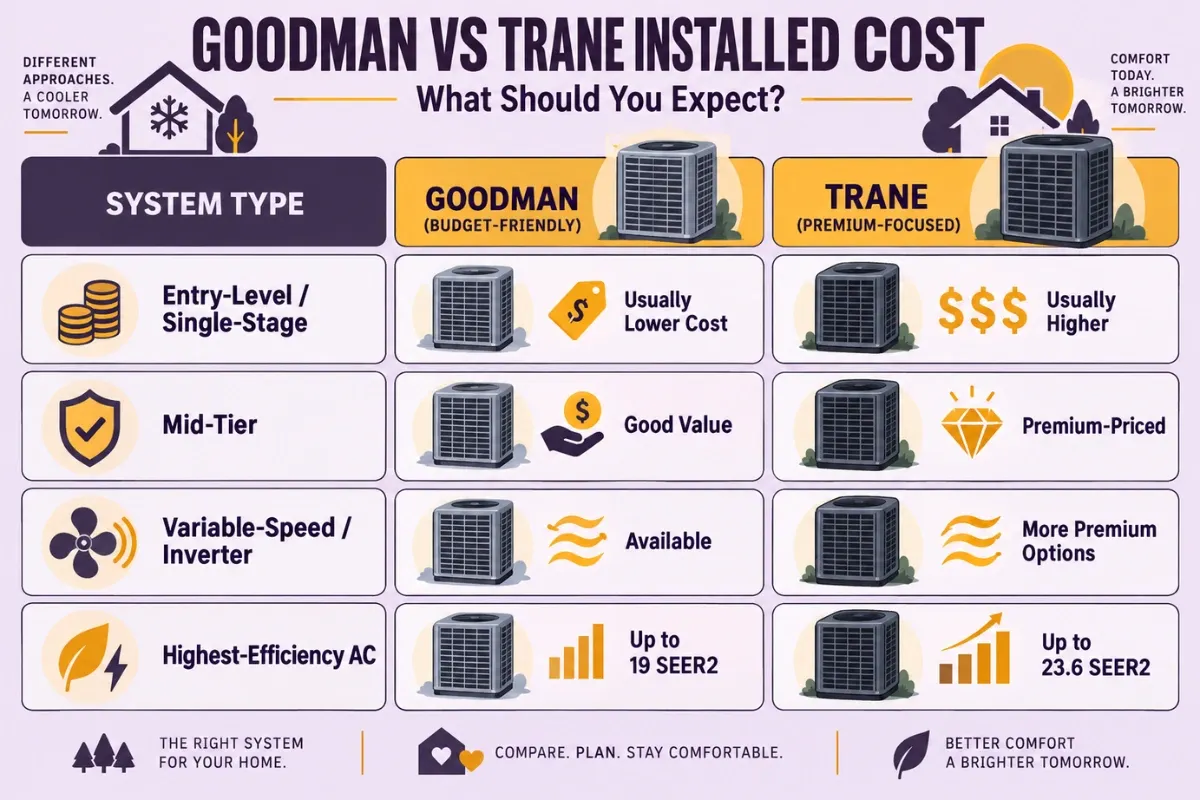
Trane goes further at the premium end. Its current 20 TruComfort Variable Speed Air Conditioner reaches up to 23.6 SEER2, while the 17 Multi-Speed reaches up to 18 SEER2.
That’s an important difference. But it doesn’t mean you need 23.6 SEER2.
What Does Trane Actually Cost?
Trane publishes national estimated replacement prices for its current lineup, which gives us a useful reference point.
For 2026, Trane lists:
| Trane AC | National Estimated Cost |
| 15 Single-Stage | $6,568–$8,544 |
| 17 Multi-Speed | $8,573–$10,671 |
| 20 TruComfort Variable Speed | $11,525–$13,669 |
These are national estimates, and Trane notes that actual costs vary by location, house, and installation needs. Accessories such as thermostats may also be extra.
That pricing pattern tells the story pretty well. Once you move from basic single-stage equipment into multi-speed and variable-speed Trane systems, you’re paying substantially more.
The question is whether you’ll notice what you’re paying for. In many Durham homes, you will.
Why Is Goodman Usually Cheaper?
Goodman has always competed aggressively on value. That isn’t necessarily another way of saying “cheap equipment.” Goodman became part of Daikin in 2012, and current Goodman products are part of Daikin’s North American HVAC business.
The difference is mostly market positioning.
Goodman gives homeowners access to solid central AC equipment without requiring every buyer to pay for premium controls, sophisticated variable-speed operation, or the highest available efficiency.
Take the current GLXS3B.
It’s a straightforward single-stage AC rated up to 15 SEER2, available from 1.5 to 5 tons. It uses R-32 refrigerant and carries Goodman’s registered 10-year parts limited warranty.
For a homeowner who wants reliable cooling at a reasonable price, that’s a solid formula. You turn the thermostat down. The AC cools the house. Not every homeowner needs more than that.
Is Goodman Only a Budget Brand?
Not anymore. This is where some Goodman vs Trane articles are behind the current product lineup. Goodman’s GXV9S is a communicating, variable-speed, inverter-driven central air conditioner rated up to 19 SEER2.
So you can buy Goodman without being locked into basic single-stage equipment.
That matters because Durham has a real cooling season. We aren’t dealing with Phoenix heat, but we do have long stretches where temperature and moisture both matter.
That’s when longer, lower-output cooling cycles start becoming attractive.
What Are You Paying Extra for With Trane?
This is the question I’d ask before spending another few thousand dollars. With comparable capacity, you’re not paying extra because a Trane can somehow produce “better cold air.”
A 36,000 BTU system is still expected to deliver roughly 36,000 BTU/h under its rated conditions. It also saves energy. What changes is how the system gets there. Trane’s higher-end equipment adds things like:
- variable-speed or multi-speed operation,
- higher SEER2 ratings,
- more precise temperature control,
- better part-load performance,
- stronger humidity-management capability,
- communicating controls,
- Trane’s Climatuff compressor technology,
- all-aluminum SpineFin coils,
- and WeatherGuard cabinet protection.
Trane’s current AC lineup runs from 13.4 SEER2 at the lower end to 23.6 SEER2 at the top, depending on the equipment combination. That’s where the price premium starts to make sense.
You’re not paying for “more cooling.” You’re paying for how quietly, smoothly, efficiently, and consistently the cooling is delivered.
Goodman vs Trane Efficiency: Will Trane Save Enough Electricity to Pay for Itself?
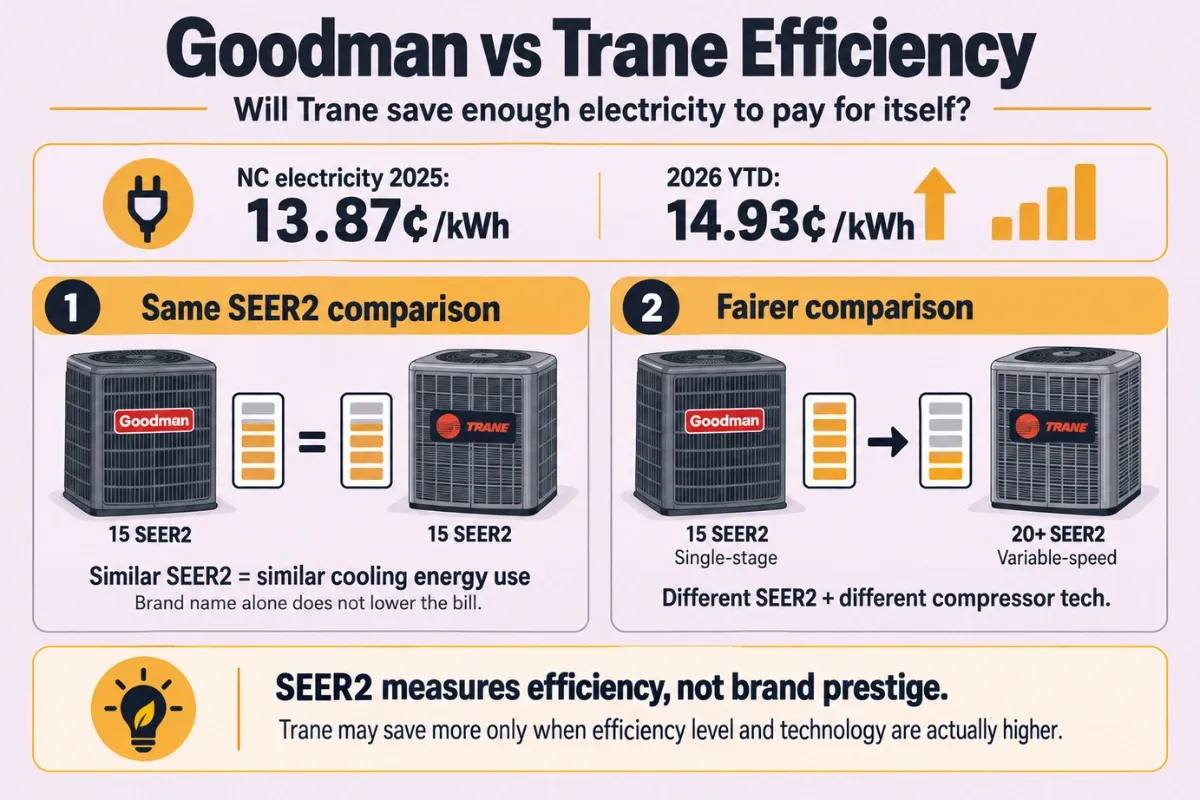
Sometimes. But don’t assume it will. North Carolina residential customers paid an average of 14.93 cents per kWh year-to-date through June 2026, up from 13.87 cents over the same period in 2025, according to the U.S. Energy Information Administration.
So efficiency certainly matters. But here’s the part sales brochures often skip.
If you’re comparing a 15 SEER2 Goodman with a similar-efficiency Trane, the Trane badge itself won’t magically lower your energy bill.
SEER2 measures efficiency, not brand prestige.
If two properly matched systems have similar SEER2 ratings, capacity, and staging, their cooling energy use should be much closer than their prices might suggest.
The math changes when you compare a Goodman 15 SEER2 single-stage system against a Trane variable-speed system capable of 20+ SEER2.
Then you’re buying a different efficiency level and different compressor technology—not simply switching brands.
That is a fairer comparison.
Is Goodman Cheaper to Repair Than Trane?
It often can be, especially on simpler Goodman equipment, but I wouldn’t promise a fixed percentage.
A basic capacitor, contactor, fan motor, or control component is one thing. A communicating inverter board is another. The more sophisticated the equipment, the more expensive some repairs can become, regardless of brand. This is one reason basic Goodman systems work well for:
- rental properties,
- budget-conscious replacements,
- owners who prefer simpler equipment,
- and homes likely to be sold within a few years.
Trane’s premium technology makes more sense when the homeowner values what it actually does.
If you’re buying a variable-speed Trane because a salesperson says it’s “better” but you don’t care about sound, humidity, temperature consistency, or premium controls, you’re paying for features you may never appreciate.
Ductwork Can Wipe Out the Savings You’re Paying For
ENERGY STAR estimates that 20% to 30% of the air moving through a typical home’s duct system can be lost through leaks, holes, and poor connections.
That’s huge.
Imagine paying thousands more for a high-SEER2 Trane because you’re trying to save electricity while 25% of your conditioned air is leaking into the attic or crawlspace.
Fix the duct problem first.
ENERGY STAR also says leaky ducts can reduce heating and cooling efficiency by up to 20%. A well-installed Goodman with sealed ductwork can easily be a smarter system than an expensive Trane connected to a bad air-distribution system.
Conclusion
For most Durham homeowners, Goodman wins on price and overall value. Trane costs more, but the extra money can make sense if you want better efficiency, quieter operation, and premium long-term comfort.
If budget comes first, choose Goodman. If comfort and long-term performance matter more, choose Trane.
Frequently Asked Questions
Is Goodman a better choice if I plan to sell my Durham home soon?
Usually, yes. If you expect to move within a few years, Goodman can make more financial sense because the upfront cost is lower. You still get a modern AC system without paying extra for premium features you may not use long enough to justify.
Does Trane’s higher price mean lower monthly power bills?
Not automatically. The energy savings come from the SEER2 rating, compressor type, system sizing, and installation quality, not the Trane name alone. A Goodman and Trane with similar efficiency ratings may have fairly similar cooling costs.
Which brand makes more sense for an older Durham home?
It depends on the house more than the brand. Older homes often have duct leakage, insulation gaps, or airflow problems. Fixing those issues may improve comfort more than simply spending extra on a premium AC.
Is a variable-speed Trane worth it for Durham humidity?
It can be. Variable-speed systems can run longer at lower output, which helps maintain steadier temperatures and gives the system more time to remove moisture. That can be useful during Durham’s humid summer weather.
Can I save money by choosing a smaller Goodman system?
Only if the smaller size is what your home actually needs. Choosing tonnage based on price can create comfort and humidity problems. A contractor should perform a Manual J load calculation before recommending the system size.