A SEER (Seasonal Energy Efficiency Ratio) rating measures how much cooling your air conditioner provides for every dollar of electricity it uses. In 2026, the industry standard will have fully transitioned to SEER2.
It’s a more accurate measurement that reflects real-world home conditions rather than ideal laboratory settings. While the federal minimum in North Carolina is 14.3 SEER2, choosing a higher-efficiency system can get tax credits up to $2,000 and provide better humidity control.
Key Takeaways
|
SEER2 Conversion from SEER
If you are replacing an older HVAC unit, you will notice that the efficiency numbers on new equipment look different. This is because the Department of Energy recently replaced the traditional SEER metric with SEER2.
The most important thing to know is that a SEER2 rating is roughly 4.5% to 5% lower than its SEER equivalent, even though the system is actually more efficient.
For example, a unit that would have been rated at 15 SEER under the old rules is now rated at 14.3 SEER2. You aren’t losing efficiency; rather, the “test” has become more difficult.
To get a rough estimate of a SEER2 conversion, you can multiply the old SEER rating by 0.95. This change was necessary because the original SEER test assumed your home had perfectly smooth, oversized ducts with zero resistance.
SEER2 testing uses 0.5 inches of external static pressure, 5 times more than the old test. It helps better simulate the actual friction air faces in your home’s ductwork.
SEER2 vs. EER2, HSPF2, and BTU per watt hour
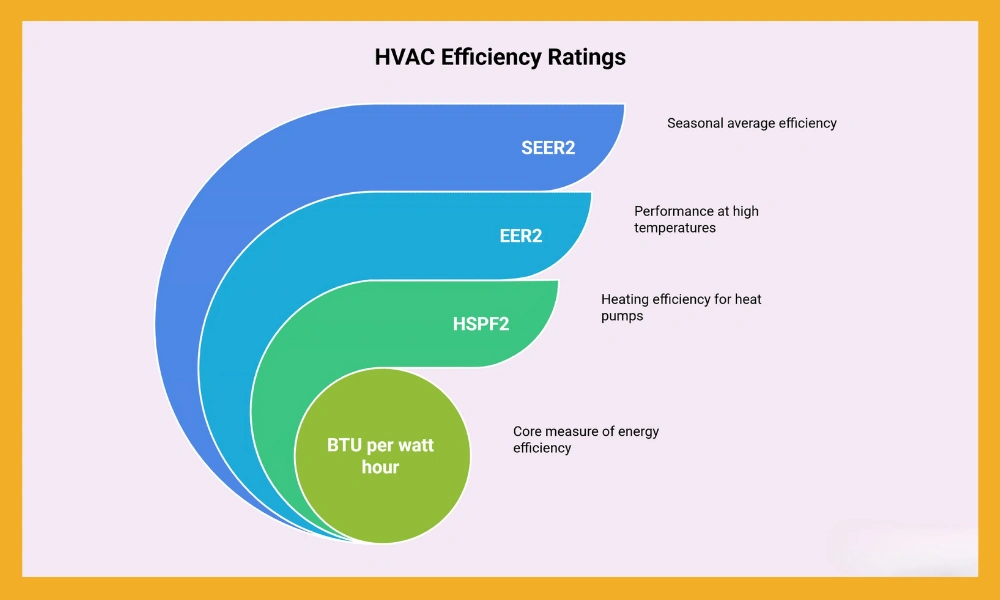
While SEER2 is the seasonal average, EER2 (Energy Efficiency Ratio 2) measures how the system performs at a single, stressful point: 95°F outside. This is crucial for the hottest days of the year.
For heat pumps, we use HSPF2 (Heating Seasonal Performance Factor) to measure heating efficiency. All these ratings essentially measure how many BTUs (British Thermal Units) of heat the system delivers for every watt-hour of electricity it consumes.
How SEER2 is Measured and Shown
The Department of Energy (DOE) mandates strict testing under Appendix M1 and AHRI Standard 210/240. Manufacturers must test units in labs that simulate various humidity levels and outdoor temperatures.
These tests verify that the blower motors and compressors can handle the resistance of a typical residential duct system. The table below is about 2026 DOE minimum efficiency requirements:
| Equipment Type | Southeast (NC, SC, GA, FL) | North (NY, IL, OH, WA) |
| Split System AC (<45k BTU) | 14.3 SEER2 | 13.4 SEER2 |
| Split System AC (≥45k BTU) | 13.8 SEER2 | 13.4 SEER2 |
| Air Source Heat Pumps | 14.3 SEER2 / 7.5 HSPF2 | 14.3 SEER2 / 7.5 HSPF2 |
| Packaged Units (AC/HP) | 13.4 SEER2 | 13.4 SEER2 |
Where you can find SEER2 label
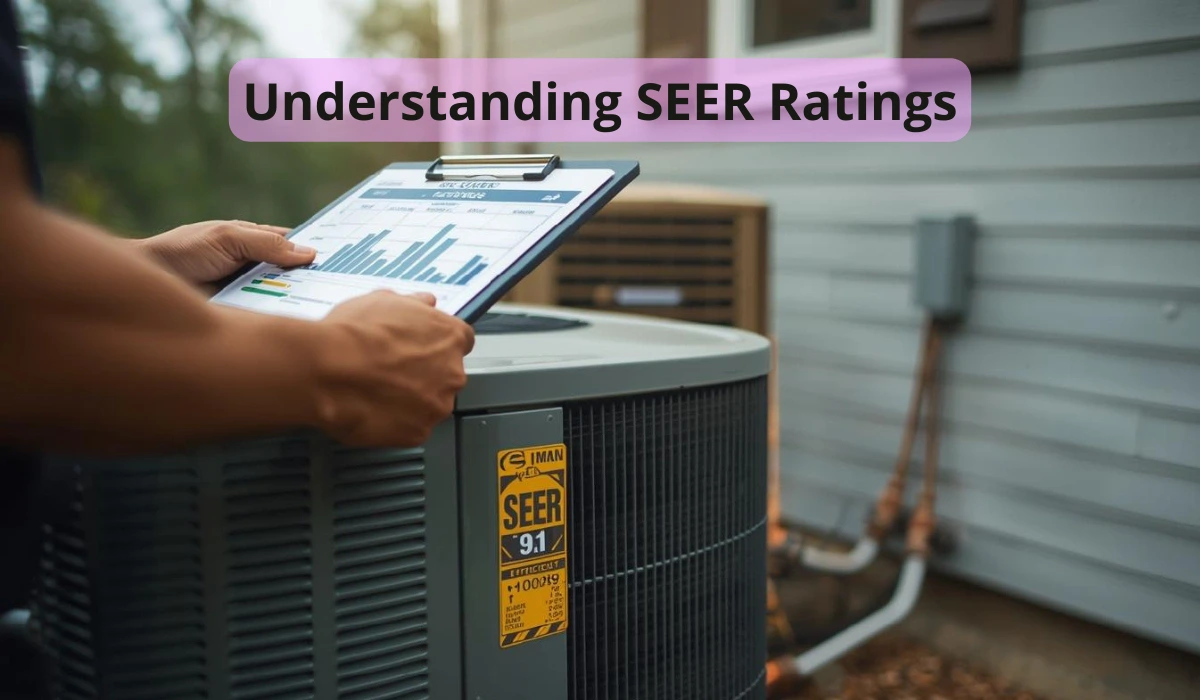
Every new unit features a bright yellow EnergyGuide label. This label displays the SEER2 rating prominently, along with an estimated yearly operating cost.
I always encourage my clients to look for the “Seasonal Energy Efficiency Ratio 2” text to ensure they are viewing the most current data.
Model verification through AHRI directory
You can verify the efficiency of any system using the AHRI Directory. By entering an AHRI-certified reference number or specific model numbers, you can confirm the exact SEER2 rating for your “matched system.”
A matched system means the indoor coil and outdoor unit are designed to work together perfectly to reach the advertised efficiency.
Types of Equipment and SEER2 Ratings
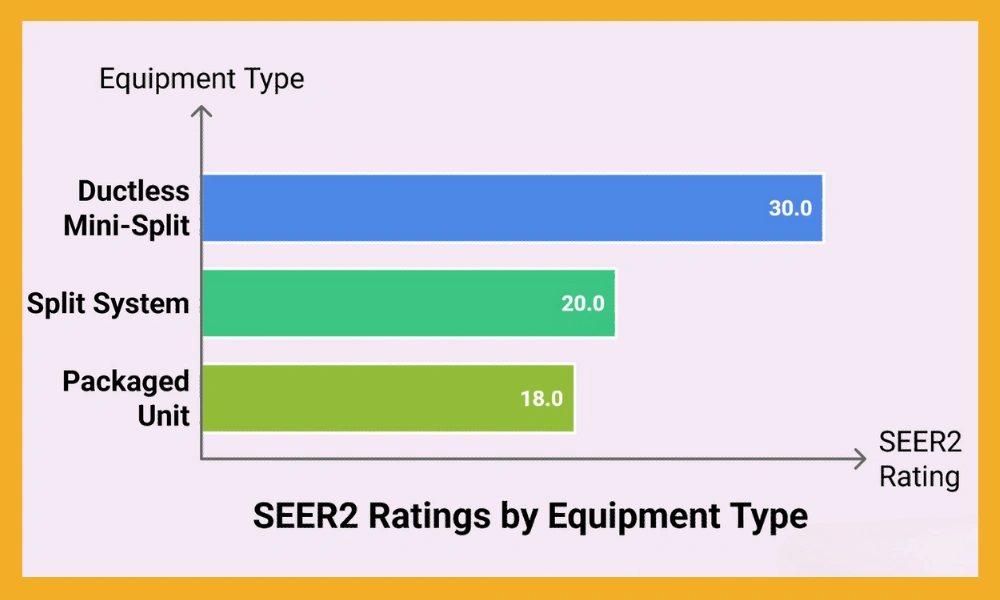
Apparently, different equipment has different kinds of SEER ratings for intense-
1. Central Air Conditioner and Split System Ratings
Most homes in our area use split systems, where the condenser sits outside, and the evaporator coil is inside. Packaged units, which house all components in one outdoor cabinet, typically have slightly lower SEER2 minimums than split systems.
2. Ductless Mini-Split and Heat Pump Efficiency
Ductless mini-splits often achieve the highest SEER2 ratings on the market, sometimes exceeding 30.0 SEER2. This is because they avoid the energy losses associated with ductwork.
High-efficiency heat pumps are now the preferred choice for many, especially when comparing two-stage and variable-speed equipment for year-round utility savings.
3. Single Stage, Two Stage, and Variable Speed Inverter Compressors
- Single Stage: Always runs at 100% capacity. It is reliable but less efficient.
- Two-stage: Has a high and a low setting. It runs on the low setting roughly 80% of the time to save energy.
- Variable Speed (Inverter): These systems act like a dimmer switch, adjusting output in tiny increments. They provide the most precise temperature control and the highest SEER2 ratings.
SEER2 Rating’s Impact on Energy Efficiency
The number on the yellow sticker is a laboratory maximum. Real-world performance depends on how well the system handles part-load efficiency during mild days and full-load efficiency during a July heatwave. We find that variable-speed systems excel here because they rarely need to run at full power.
Ducts, Airflow, and Installation Quality Change Actual Efficiency
A 20 SEER2 unit attached to leaky or undersized ducts will perform like a 14 SEER2 unit. Proper airflow is essential for the heat transfer process.
To maximize your investment, consider filtration and dehumidification add-ons that boost comfort, which keep your coils clean and your air moving freely.
External Static Pressure and Duct Leakage
High external static pressure forces the blower motor to work harder, increasing electricity consumption. Sealing duct leaks and removing return-air restrictions ensures the energy you pay for actually reaches your living spaces.
Commissioning and Refrigerant Charge Verification
Our team at Alternative Aire follows a strict commissioning checklist for startups. Verifying the refrigerant charge and measuring the fan watt draw are critical steps. Even a small error in the refrigerant level can lower the effective SEER2 of a brand-new system.
How SEER2 Affects Your Utility Bill
SEER2 directly impacts how much electricity your HVAC system uses to cool your home. A higher SEER2 rating means better efficiency, lower energy consumption, and reduced monthly utility bills. Here is how-
1. Lowering Monthly Cooling Costs
The primary benefit of a high SEER2 rating is a lower electricity bill. If you upgrade from an old 10 SEER unit to an 18 SEER unit, you can expect to reduce your cooling power consumption.
Average residential electricity rates in North Carolina were hovering around 15¢/kWh on average in early 2026. Your bill might vary by utility (e.g., Duke Energy ~14.8¢). The efficiency of your system has a massive impact on your wallet.
Moving from an older, inefficient unit to a modern high-SEER2 system can slash your cooling costs by over 45-50%.
Based on DOE and Energy Star data, here is how much a typical North Carolina household can save annually when upgrading from an old 10 SEER system:
Annual Cooling Cost Comparison (Typical NC Home) This chart assumes 1,500 cooling hours per year at $0.15/kWh.
2. Cost Versus Savings and Payback Period
While higher SEER2 systems require a larger initial investment, the lifecycle cost is often lower. We provide a SEER2 savings calculator during our consultations to help you estimate the payback period based on current electricity rates and your typical usage.
| 2026 Incentives and Compliance BoxFederal Tax Credits: Under the Inflation Reduction Act (25C), homeowners can claim 30% of the cost of a high-efficiency heat pump, up to $2,000 annually. Local Rebates:Programs like Energy Saver NC offer significant rebates for residents in North Carolina, up to $16,000 for efficiency upgrades (like insulation, air sealing, and HVAC) via HOMES, or up to $14,000 for appliances/electrification (like heat pumps) via HEAR. Low-income households get 100% coverage; moderate-income households get 50%. |
As you can see, an 18 SEER2 variable-speed system costs roughly half as much to operate as a 10 SEER unit from a decade ago. For a 3-ton system in NC (1,500 hours, ~15¢/kWh), upgrading saves ~$250-300/year, or ~$3,750-4,500 over 15 years (before inflation).
When you factor in the $2,000 Federal Tax Credit and local Energy Saver NC rebates, the “premium” system often becomes the most affordable choice in the long run.
How to Choose the Right SEER2 Rating
Choosing the right system is a journey. Use this checklist to guide your decision.
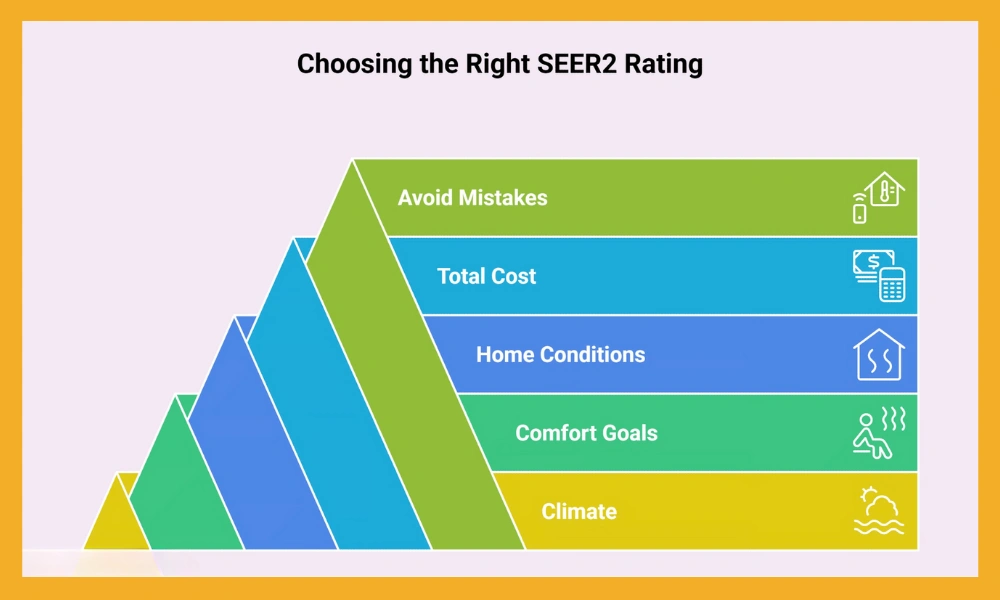
Step 1: Start With Your Climate
In North Carolina, our long, humid summers make efficiency a priority. You need to understand how to balance efficiency and cost for SEER2 in NC before making a final choice. While the minimum is 14.3, an 18 SEER2 system often pays for itself much faster here than it would in a cooler climate.
Step 2: Match SEER2 to Your Comfort Goals
If your home feels “sticky” in the summer, consider upgrading to a variable-speed heat pump or air conditioner to better manage humidity and comfort. High SEER2 variable-speed systems are the champions of moisture removal because they run longer, slower cycles.
Step 3: Look at Existing Home Conditions
Always perform a Manual J load calculation to ensure the system is right-sized. An oversized system will “short cycle,” which ruins efficiency and leaves the air humid. Check your insulation levels and air sealing, as these factors determine how hard your new system has to work.
Step 4: Compare Total Cost, Not Just Efficiency
Focus on the lifecycle cost. A mid-range 16 or 17 SEER2 unit often provides the best balance of upfront price, tax credit eligibility, and monthly savings for many Triangle homeowners.
Step 5: Avoid Common Mistakes
Once your system is installed, use the best ac temperature settings for summer to keep your bills low. Moreover, adjusting your thermostat for better humidity control during summer can make you feel cooler even at higher temperatures, which can lead to further energy savings.
Conclusion
Understanding SEER2 ratings is the key to a comfortable, cost-effective home in 2026. By focusing on the SEER2 you ensure your HVAC system is tested for modern home conditions.
While federal minimums provide a baseline, the real value lies in matching high-efficiency technology with professional installation and proper maintenance.
Whether you prioritize the $2,000 federal tax credit or the superior humidity removal of an inverter compressor, Alternative Aire is here to help you navigate these choices.
Frequently Asked Questions
What SEER2 do I need to qualify for a rebate?
Most 2026 federal credits require a split-system AC to be at least SEER2 ≥ 17 and EER2 ≥ 12, or a heat pump to be at least 15.2 SEER2.
How much will I save going from 14.3 to 16 SEER2?
Expect 10-12% savings on cooling bills. For a typical NC home (1,500 cooling hours/year, 3-ton system), that’s about $40-60/year at current rates.
Is variable speed worth it for humidity control?
Yes. Variable-speed technology is the most effective way to maintain a consistent 45-50% indoor humidity level.
Should I prioritize SEER2 or comfort features?
Ideally, both. However, a 16 SEER2 variable-speed unit often provides more comfort than a 19 SEER2 two-stage unit.
Does a high SEER2 rating increase my home’s resale value?
A high-efficiency system significantly boosts your home’s marketability and can increase appraisal value.